Translated by OfferLand from the original Traditional Chinese post. View original

Nelson Chang
Mar 17
My High-Score TOEFL Experience
School and program: Kang Chiao International School, high school
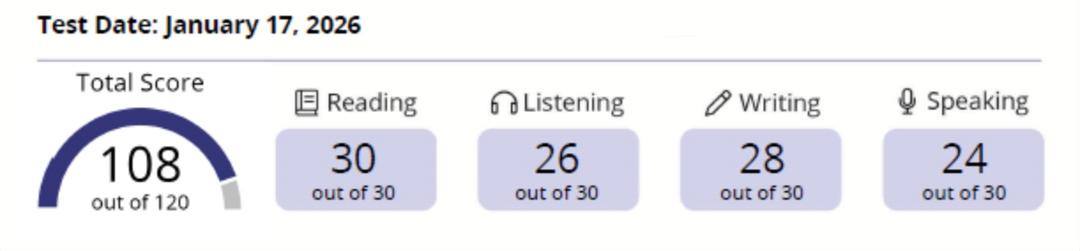
Scores: first attempt R30, L 26, S 24, W 28, total 108
Test date: first attempt 2026/1/17
[Prep notes & methods by section]
[Reading]
The biggest shift in my TOEFL reading prep came from an idea my teacher drilled into us: “reading isn't translation, it's logical judgment.” In class the teacher kept stressing that the questions test “paragraph function,” “the author's attitude,” and “cause-and-effect and contrast,” not word-by-word understanding of every vocabulary item. So on test day, even when I hit academic words I didn't know, I didn't panic; I could use the context to quickly work out which way the answer pointed. Compared with the prep books on the market, the biggest strength of the teacher's own reading handouts is how clearly they sort the question types, such as main idea, inference, reference and sentence insertion. Each type has a set solving process and order of thinking, so you don't have to guess all over again what the test writer had in mind for every question, which helped enormously with time management. Class also covered the teacher's list of high-frequency academic vocabulary and analysis of paragraph structure, and both my reading speed and accuracy improved noticeably. This training didn't just get me a perfect TOEFL reading score; it also helps me pick out the key points faster when I read English articles or outside materials.
[Listening]
Listening was always the section I felt less sure about, but the teacher's point that “listening isn't about understanding everything, it's about catching the key signals” helped me a lot. Things like transition words, examples, shifts in the professor's attitude and concluding sentences were all specially marked, so I knew exactly where I had to take notes.
The teacher's listening handouts don't just play the audio and check answers. They break down the logic behind each question and teach us how to work backward from the question to the information that actually matters in the recording. Because of that, even when I hit fast speech or very academic passages on the test, I stayed calm and didn't give up on a whole passage just because I missed one sentence.
After class I also practiced with the audio files the teacher provided and followed the teacher's suggestions on note-taking, and gradually built my own note-taking habits. This training raised my TOEFL score and also helps me take in information more effectively when I listen to English talks or watch videos.
[Speaking]
My biggest takeaway from the TOEFL speaking course was turning a vague idea of “speaking English” into structured, template-based output. The teacher gave us very clear answer frameworks, so I knew how to open, develop and wrap up each task instead of making up content on the spot. The teacher also pointed out common ways to lose points, like going off topic, repeating words and unclear logic, and taught us to express ideas with simple but accurate sentence patterns. For a student like me, who tends to think of too much to say and then runs out of time, this was really practical. I also used the speaking practice and feedback resources from Wordgod (字神), and through repeated revision I slowly built confidence. The course helped me perform consistently on the test and also made me more willing to speak up, and more organized, when I use English day to day.
[Writing]
The biggest change the writing course made for me is that I'm no longer afraid to start writing. The teacher clearly broke down what graders look for in the independent and integrated tasks, so I understood that high-scoring essays value “a clear position, logical structure and consistent language,” not necessarily the most complex sentence patterns.
The teacher's integrated-writing notes and common sentence patterns let me apply a structure quickly on the test and spend my time organizing content instead of getting stuck on how to start or how to paraphrase. The sample-essay analysis in the teacher's own handouts also showed me clearly how high-scoring and mid-scoring essays differ.
Through lots of practice and revision, I not only got a 28 in TOEFL writing but also clearly felt my logic and expression in English writing improve, which will help a lot with academic writing in the future.
[Study plan]
My TOEFL prep wasn't a short, intensive sprint. I started taking Wordgod's courses in March last year, built a foundation, then spent a long stretch absorbing it alongside my schoolwork, and only sat the real test in January this year. So my study plan focused on “making TOEFL prep part of everyday learning instead of an extra burden.” During the summer classes, I concentrated on fully absorbing the solving concepts and answer frameworks for each section. The Wordgod teachers had already systematically organized the high-frequency test points and set processes for reading, listening, speaking and writing, so in the semesters that followed, even without much time to grind through practice questions, I knew exactly how to practice, check and correct each section. Once the semester started and schoolwork got heavy, I deliberately practiced TOEFL less often and switched to a “low frequency, high quality” approach. For example, on weekdays I used spare moments to keep my feel for reading and listening, and on weekends I did full speaking and writing practice. The teacher's own handouts and ready-made templates let me get back into it quickly without rebuilding my thinking from scratch, which was key to handling schoolwork and the test at the same time. In the last few months before the test, I went back over my key notes and the common-mistakes lists from the Wordgod courses and fine-tuned my prep based on mock test results, rather than redoing everything. This let me gradually bring myself back up to test level without hurting my school grades. Overall, Wordgod's course design and prep resources let me connect what I'd learned and keep internalizing it even with “a gap between taking the classes and taking the test,” and in the end I performed consistently on my first attempt this January. This long-term approach also helps me keep my pace and direction when schoolwork and a major exam run side by side.
[Test center report]
I took this TOEFL at the in-person test center of the Foundation for Scholarly Exchange (Fulbright Taiwan). Overall, the equipment and procedures were well organized, so I could finish the test feeling fairly settled and at ease. On equipment, the computers and headphones were in good condition, the screens were clear, everything ran smoothly and the test system responded normally, with no crashes or lag. The headphones blocked noise reasonably well and I could hear the listening content clearly, which is a plus for a test like TOEFL that needs intense focus. As for procedures, check-in, ID verification and seating all had clear instructions and staff guiding you, so things went smoothly and test takers didn't feel flustered. The proctors were professional, explained the rules clearly and patiently, and helped right away if someone had a question about the system or the process, which kept the whole atmosphere calm and orderly. One thing to note: during the speaking section, other test takers in the room are answering at the same time, so you will hear other people's voices to some extent. If you practice speaking with background noise before the test, it will help you perform on the day. Still, overall the center's management is within an acceptable range and doesn't really disrupt your pace. In short, the Foundation for Scholarly Exchange TOEFL center does well on equipment reliability, procedures and proctoring, and it's a good choice if you want a place where you can focus. As long as you're mentally prepared for background noise during speaking, the overall test experience is positive and reassuring.
[Words of encouragement for other test takers]
Before I formally started preparing for TOEFL, I took a mock test at Wordgod and scored only 58. Even after a period of coursework, my mock test a week before the real exam was only 88, and honestly, I didn't feel ready then. Looking back, though, the process taught me one thing: a mock score isn't your ceiling; it's a reminder of how to adjust your direction. The solving concepts, answer frameworks and ways of thinking I learned in the Wordgod courses had already sunk in over time; they just needed to come out in full, all at once, in the real test. Getting 108 on the real test in the end wasn't a miracle. It came from choosing to trust the right method and keep building my skills through low scores, anxiety and uncertainty. To you, whether you're working hard right now or about to set out on the study-abroad testing road: don't let any single score define you. As long as you're heading in the right direction, progress will show up when you least expect it.
[Score report]