Translated by OfferLand from the original Traditional Chinese post. View original

嘉嘉在UCL
Updated Dec 8, 2023
How I Got IELTS 7.0 on My Fifth Try
First, my final score
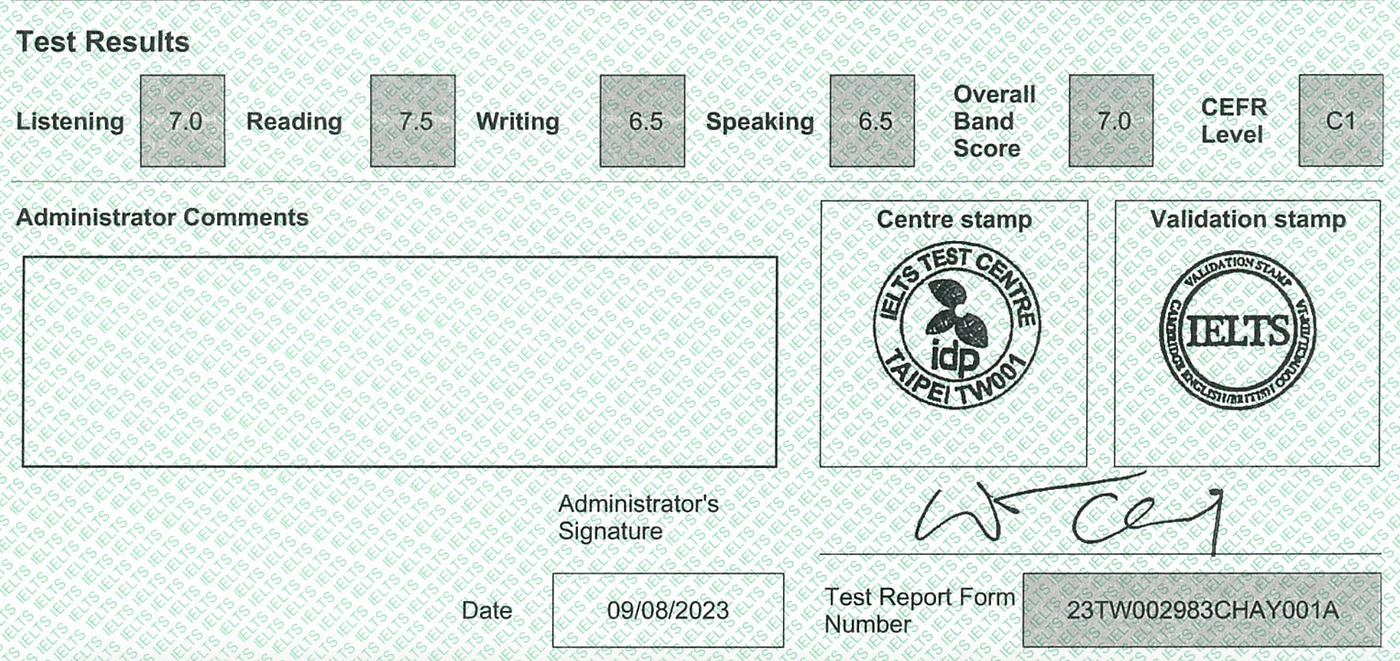
Here's how my scores evolved:
IELTS: 7.0 (L7.0 R7.5 W6.5 S6.5) — 2023/08/06
IELTS: 7.0 (L7.0 R8.0 W6.5 S6.0) — 2023/07/08
IELTS: 6.5 (L7.0 R6.5 W6.0 S6.5) — 2023/06/19
IELTS: 6.5 (L6.0 R7.0 W6.0 S6.5) — 2023/05/28
IELTS: 6.0 (L6.5 R6.5 W5.5 S6.0) — 2022/12/18

This picture sums up exactly how I felt
Intro
My English was originally at roughly a TOEIC 830 level. I decided to take IELTS because I was applying to grad schools in the UK, but I'm a bit lazy, the kind of person who doesn't study without pressure. So I only made up my mind to prepare seriously after I'd submitted all my applications, and started studying for IELTS in earnest around early 2023. I first took a one-month prep school course, then studied on my own following the plan the prep school gave me. Here's what I learned over five attempts (。•ㅅ•。)♡
Listening
IELTS listening has lots of question types: maps, multiple choice and fill-in-the-blank
At first, what scared me most was part 4 and the map questions (me, with zero sense of direction)
But after I learned some techniques at the prep school, listening didn't feel that hard anymore!
Here are some tips
A. Catch the keywords
In listening, keeping up with the pace really matters. That's why you need to learn to mark keywords so you can tell which question the recording has reached. Here's a real question to explain:
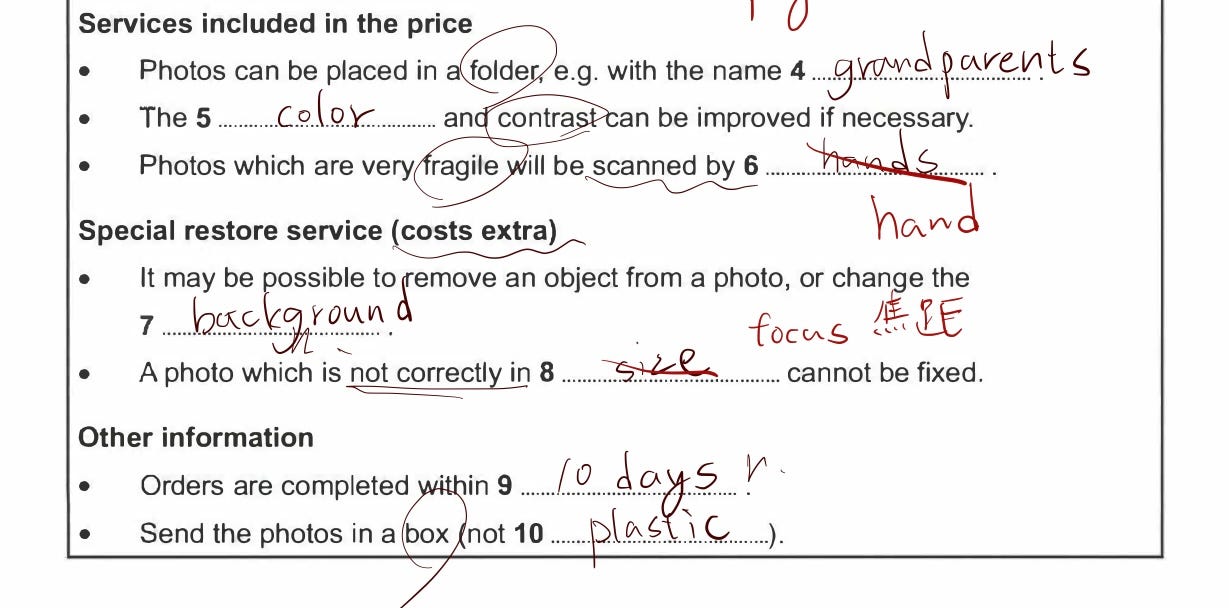
Sorry about my ugly handwriting
For question 4, I circled folder, so as soon as I hear folder I get ready for the answer. For question 5, I circled contrast, so whenever I hear that word, the answer is probably related to question 5
And so on
Also, what comes after a transition is usually the key point! (like but, however, instead, nevertheless, etc.)
Honestly, I think listening is one of the easier sections to improve quickly, because there are shortcuts
For this part, I think a teacher at a prep school can probably explain it more clearly XD
B. Get familiar with paraphrasing
What is paraphrasing?
Have you heard the lyrics of OSN's (高爾宣) without you?
I’m still the same
都好像沒有變 (nothing seems to have changed)
Nothing changed
These three lines all mean the same thing but say it in different words. That's paraphrasing
IELTS listening and reading are full of these synonym swaps
For example, have to might show up as must, should, need, require, necessary or be supposed to…
This skill is really important in reading too!!!
C. Do intensive listening
Personally, I think this method is super painful but super useful
What is intensive listening?
step1: Listen to one sentence blind and guess roughly what it says
step2: Play the same sentence again and write down what you hear
step3: Play it again and fill in what you missed the second time
step4: Play it again and fill in what you missed
step5: Check against the transcript and correct it
step6: Figure out why you got it wrong: was it a word you didn't know, or a word you knew but didn't catch?
Do this for every sentence and your listening will improve a lot
The material I recommend most for intensive listening is Cambridge IELTS
I think practicing Cambridge IELTS from the latest, 18, back to 13 is about enough
To practice intensive listening, you can download the 雅思哥 (IELTS Ge) app, which has the questions and audio files
D. Learn to let go
If you really miss an answer, don't cling to it
It's just like meeting the wrong person
Never, ever keep looking back and agonizing, or you'll miss the chance to meet a new love!!
If you didn't catch the answer, let it go. We have to learn to look ahead
Dwelling on an answer you missed makes it easier to lose the rhythm and lose points on the whole section

2. Reading
A. You don't need to read the whole passage
The first time I did the reading section, I couldn't finish. Now I can finish and still check my answers
The technique I learned is basically to catch the keywords
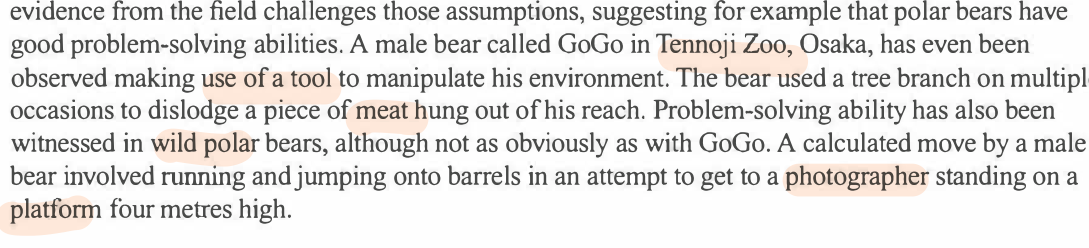
Read the questions first, pick out the distinctive words, then locate which paragraph the answer is in. That way you don't have to read every paragraph

For question 9, there's a distinctive name, Tennoji Zoo, so I look for the paragraph in the passage that mentions it, and that's where I find that the answer is tool
B. Don't answer in order
At first I naively answered the questions in order, and only later realized how inefficient that is
Some question types follow the order of the passage, which makes finding information more efficient
The order I learned later is: fill-in-the-blank>judgment (T/F/NG)>multiple choice>matching>heading
I do fill-in-the-blank first because the information is easiest to find: once you catch the keyword, you can easily locate the paragraph and fill it in without understanding the text before it. The same goes for judgment and multiple-choice questions
But for heading questions, you usually have to read the whole passage to be sure, so I usually leave them for last
C. F or NG?
I spent a long time on this age-old puzzle too
But then it suddenly clicked overnight!
You usually choose F when there's an obvious error: you can find a sentence that proves the statement is wrong
You choose NG when it isn't specifically mentioned, or there isn't enough evidence!
IELTS often swaps concepts on you, and sometimes this is really a test of logic that has nothing to do with English (´・ω・`)
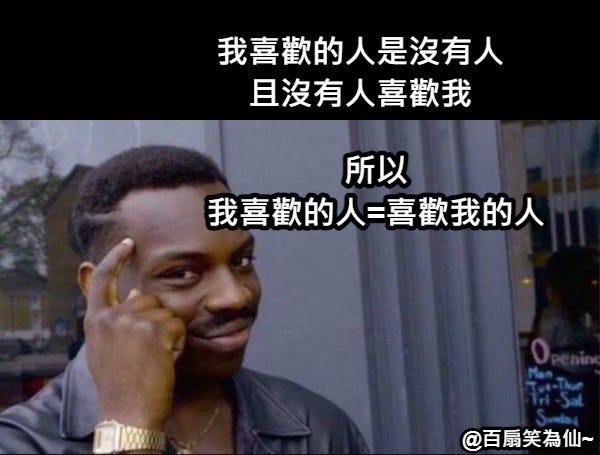
Quiz time: is this one T, F or NG?
D. Understand long, difficult sentences
IELTS reading often has long, complex sentences that run several lines, so long that by the end you've forgotten what the beginning said QQ, let alone understood the whole thing
But it's exactly these sentences that often hold a lot of information, so when you don't understand one, you have to break it down, analyze it and figure it out. If you can't on your own, get someone to explain it to you!
For example, participle clauses never made sense to me back then
If you don't know what a participle clause is, you can watch this video
📍Here's a little secret: if you want to practice reading, search online for「IELTS Cambridge pdf」and you'll find electronic versions to download, so you don't need to spend money on them
3. Writing
If you don't know what IELTS writing tests, look here
It's basically split into Task 1 and Task 2
Here are a few things I learned:
A. Essay structure
IELTS writing has its own structure! If you follow the logic of the structure, you'll get at least a 6
I built my writing structure at the prep school. Back then I didn't know how to write and just wrote whatever, and got only 5.5. The teacher taught us some all-purpose structures, and I kept using them. My score went up 0.5 right away
If you want to understand the structure, you can also watch Simon's explanation videos. He's a former examiner, and his videos helped a lot with writing techniques and concepts. I really recommend understanding the exam rules and techniques before you take the test. You'll get twice the result for half the effort!
B. Build up ideas for topics
The writing section really doesn't test just your English. It tests your thinking and cultural background too!!
For a lot of topics, I'd run out of things to say even in Chinese…
Really, you just need to build up general knowledge in everyday life
When I have no ideas, I copy the question into Writing 9 to read essays other people wrote, and I also follow 黄Yào师 on Xiaohongshu, where I once saw him share a question identical to the one I got in the exam. Both helped my writing ideas a lot
When a question is really tricky and you can't think of anything, you can also ask the almighty chatGPT. It might open up a whole new world for you
C. Have a teacher grade your writing
IELTS writing isn't only about English. It tests logic, precise word choice and ideas even more. Sometimes you don't get a high score not because your English is bad but because the essay structure isn't right, and you'll never spot the problem by reading it yourself (as they say, onlookers see more clearly than the players)
So I truly believe that if you want to improve your writing, you absolutely, absolutely, absolutely need a teacher to grade it
Whether it's a prep school or a private tutor, just don't keep practicing on your own without reviewing
D. Write!
Unlike reading and listening, writing doesn't have test tricks for quick gains. Improving your writing comes down to one word: write!!!
Keep writing and writing, and keep getting it graded and reviewed by a teacher. That's how you improve
Of course, building up ideas in everyday life matters a lot too
I put more work into Task 2 because it's weighted more heavily
For how the scores convert, see the chart below:
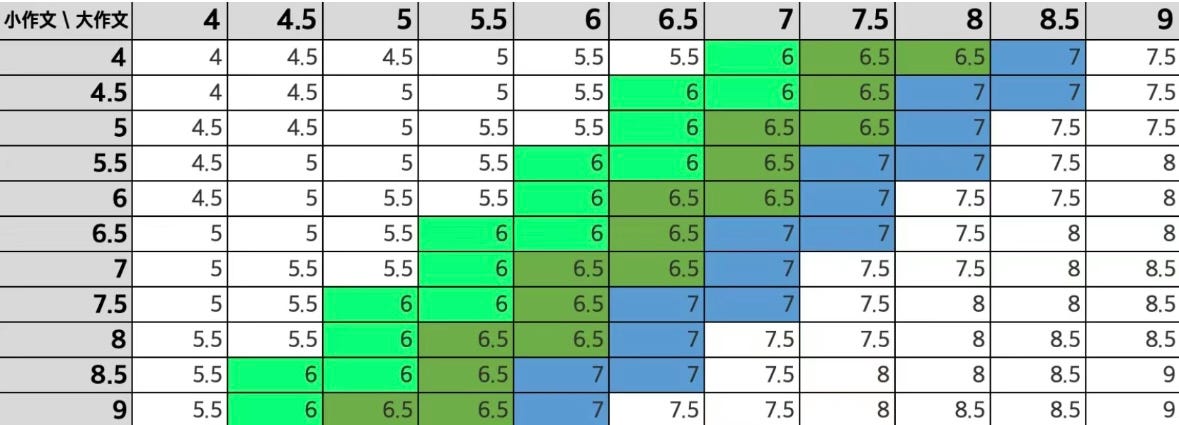
If your target is 6.5, a 6.5 on Task 2 is enough, and a 6 on Task 1 is fine
4. Speaking
Have you seen this picture?
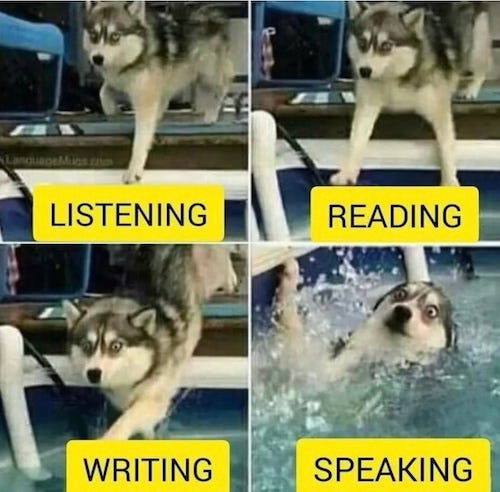
I think speaking is a big weakness for Taiwanese students, because none of the exams we take growing up test speaking, and TOEIC only tests listening and reading. So it's completely normal to be bad at speaking
It was also my weakest section, so I tried a lot of methods before finding the most effective ones!
A. Know the question bank well
Luckily, IELTS speaking has a question bank!
The one I used most is 雅思哥 (IELTS Ge)
Before each test I always went through the whole question bank. After getting familiar with every question, I could tell which one the examiner was asking before they finished
Whether to practice every question is up to you. For Part 2 I always wrote a draft for every question; for Part 1 and Part 3 I only memorized answers to the hard ones

Part 2 without a draft? Sorry, I can't even do that in Chinese
B. Linking topics
This is a method Edric taught me at the prep school, and I found it really useful!
Linking topics means preparing one set of answers and reusing it across different questions
Example:
The part 2 questions in my speaking test that time included:
a. A faraway place you'd like to visit in the future
b. An interesting place
c. An adventure you'd like to have
d. A water activity you'd like to try
I answered all four with "going surfing at a golden beach," which made my prep much more efficient
BUT!!! Linking that's too obvious won't work. For "an interesting place," for example, talking about surfing the whole time would be pretty weird. Some examiners are quite sharp and can tell you're sneaking in a linked answer, which might cost you points (✺ω✺). So later my strategy was to link only one short section and answer the rest based on the actual question
What a lot of people don't know is that you can link topics in part 3 too
I heard about it from someone on Xiaohongshu and it opened my mind. If you want the details, watch this video
It's basically preparing a few all-purpose stories and using them wherever they fit
C. Body language and vocal variety
I clearly remember what my tutor told me back then: Speaking test is a show. You have to find a way to entertain the examiner
That's right, the speaking test really is a show
After all, you're face to face with the examiner. Besides what you say, your body language, facial expressions and voice are all part of how you express yourself (they're also key to sounding less memorized)
Feel free to be as dramatic as you can. Imagine you're acting in a TV drama
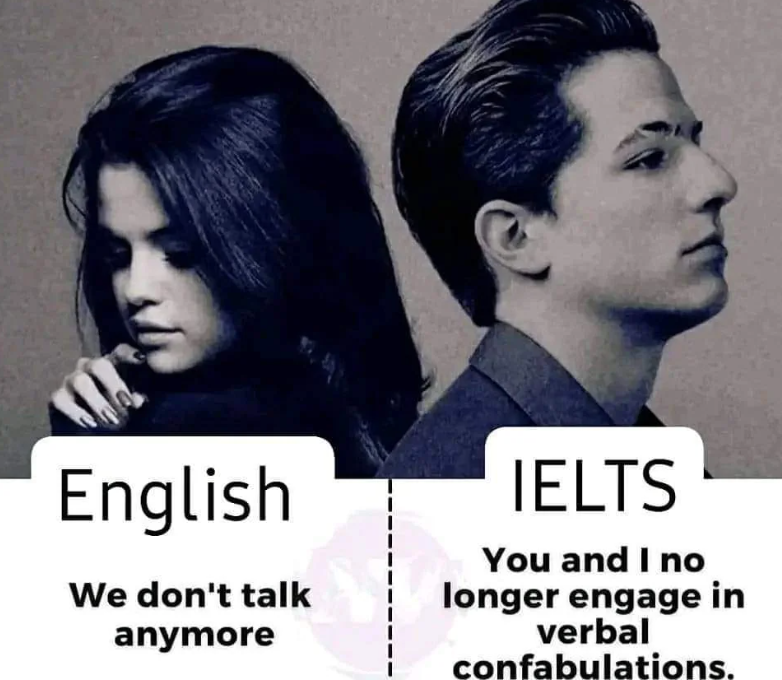
What five speaking tests taught me: taking IELTS is all about putting on an act!!
Also, make plenty of eye contact with the examiner. If you get nervous, download a picture of someone who looks like an examiner and stare at it every time you practice answering (um... that's how I got over my nerves)
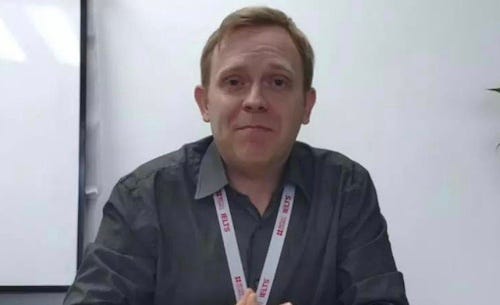
Staring at this picture, you feel the pressure instantly, right XD
D. Make good use of ChatGPT for part 3
What if some part 3 questions are so tricky you really can't think of anything?
Besides looking for sample answers people share on Xiaohongshu, I prefer to use chatGPT
For this test's part 3 question, "How are students who take a GAP year different from other students," I thought for ages and couldn't come up with a good answer, but chatGPT listed several points right away and opened up my thinking
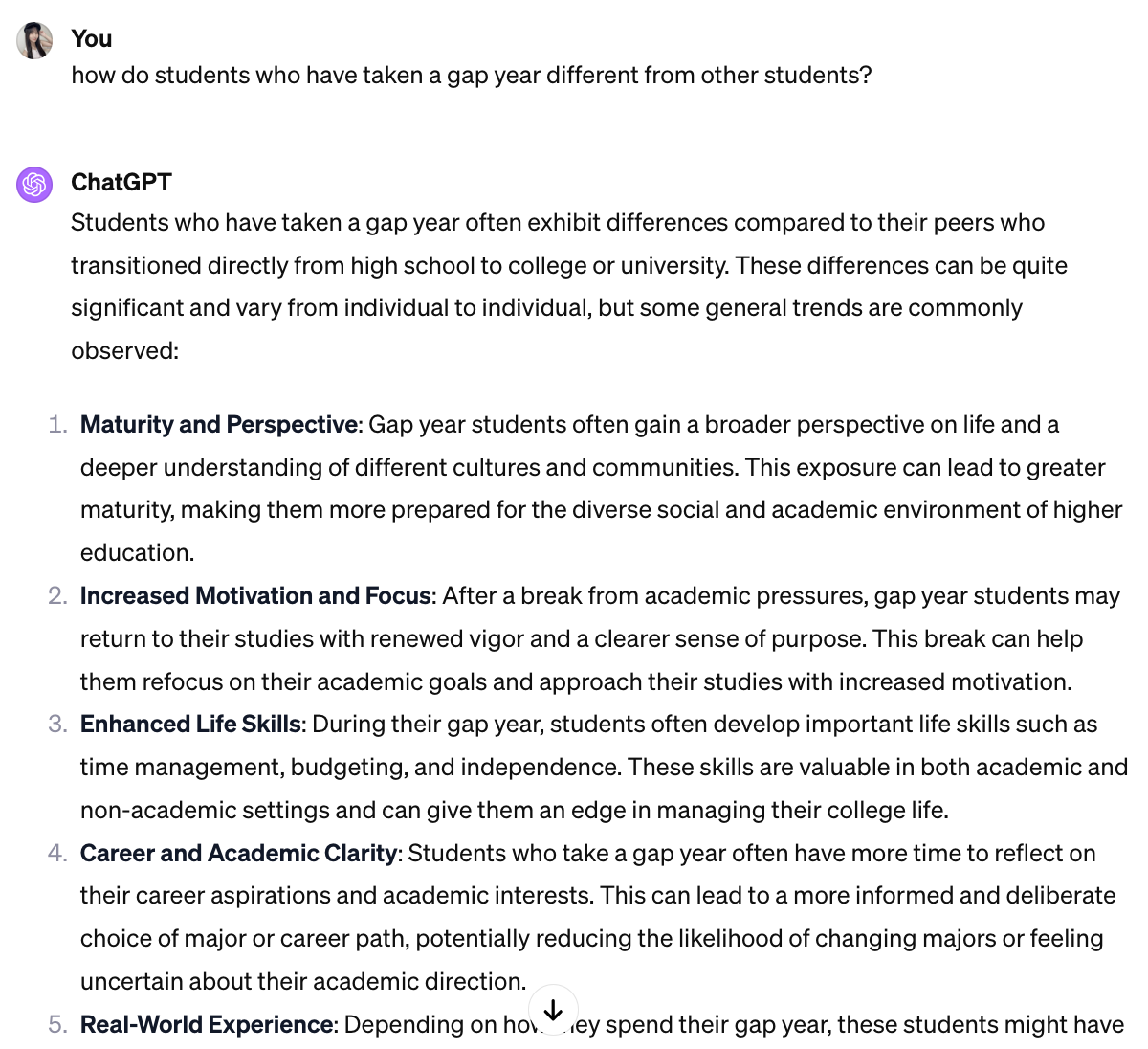
I think part3 questions are a great fit for brainstorming with chatGPT. It gives fairly comprehensive answers to almost every question, and you just pick a few points you agree with, tweak them and use them
📍A small tip: speaking questions change every January, May and September. If your speaking isn't strong, it's better to wait until the question bank has settled before taking the test
Q&A
1. What if I have no motivation?
A lot of people have this problem, and so did I
How I dealt with it: after each test, if my score wasn't good enough, I'd immediately register for the next one. That way I couldn't slack off, because slacking off meant losing the 7500 registration fee ヾ(;゚;Д;゚;)ノ゙
Of course, by then I already had my UCL offer, so I also gave myself a deadline. My mindset was: do my best and leave the rest to fate. I'd try my hardest, and if I didn't get the score by mid-August, so be it, I just wouldn't go! (Yep, that headstrong)
2. Computer-delivered or paper-based test?
I personally recommend the computer-delivered test, because there are more test dates and results come out faster
But I'd suggest practicing with 雅思哥 first to get used to the computer test's interface and question order
That way you won't panic as much on test day
3. Do I need to buy extra books?
I only used Cambridge IELTS and the materials from the prep school
I didn't spend much on books. Personally, I don't think it's necessary
4. Should I go to a prep school for IELTS?
If you already have a decent foundation and your IELTS overall is 6.5 or above, I think you can just self-study your weaker sections
But if you're starting from zero, have never encountered the IELTS exam, or feel you don't prepare efficiently, then I think going to a prep school to learn about the exam systematically is more efficient. Instead of figuring out how the exam works on your own, having a teacher guide you really saves a lot of time
The prep school I went to was Churchill English (邱吉爾英語). I think Edric really knows IELTS test strategies inside out. My IELTS improved a lot after the full course, and since the classes are small, everyone gets attention and the pace adjusts to how the class is doing.
Going to a prep school really helped me prepare for IELTS, especially for listening and reading. IELTS has a lot of test-taking techniques and unwritten rules that you might never discover on your own. I'm really grateful to Edric for saving me from a lot of detours (ゝ∀・)⌒☆
And what touched me most is that even after the course ends, Edric adds everyone to a group chat where you can join vocabulary quizzes, study groups and one-on-one speaking practice every week. It's a big motivation boost!
Finally, good luck with your IELTS, and may you become an even better version of yourself♡

[Studying in the UK] 🇬🇧My 2023 UK grad school application experience (admitted to UCL/KCL/QMUL)
👉🏻For more of my study-abroad life, follow me on IG: snsdlike1
Schools in this post
See each school's applicant numbers, admit rates and past applicants' results
See admission data for these schools