Translated by OfferLand from the original Traditional Chinese post. View original

劉育麟
May 31
[Zishen TOEFL High-Score Write-up]
School and major: Nanjing University, Software Engineering
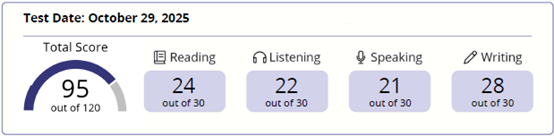
Scores: 1st attempt R17, L17, S18, W20, total 72; 2nd attempt R26, L18, S20, W24, total 88; 3rd attempt R24, L22, S21, W28, total 95;
Test dates: 1st attempt 2025/08/02; 2nd attempt 2025/10/04; 3rd attempt 2025/10/29
[Prep Notes & Approach by Section]
[Reading]
Drilling lots of questions to find their key logic and clauses is what raises your reading score; the core of reading is grasping the logic. I usually skim the first sentence of each paragraph to understand the passage's structure, then go back to the text for each question. Reading academic articles regularly to get a feel for background knowledge in different fields also helps. Most important is practicing your reading speed, so you can quickly pick out the key words when you hit a long, difficult sentence.
[Listening]
Listening is the section I spent the most time practicing. There are two schools of thought: taking notes and not taking notes. Some people like taking notes and some don't. I tried both. Taking notes makes it easy to get distracted and miss things, but without notes it's easy to forget things. I found that structured notes help me remember the key content and the order of the logic, so I ended up in the note-taking camp, but I keep my notes as short as possible and only write down key words. With enough listening, you get a sense of which key words the lecturer will use.
[Speaking]
TOEFL speaking is actually very formulaic, with much the same questions and structure every time, so it's important to prepare a set of answer templates. Ideally, have a rough template for how to build every sentence, so on the real test you're just filling in blanks and swapping out parts of fixed sentences. This keeps you from running out of words, gives you something to say quickly during the test, and makes it less likely you'll forget how to put your answer together. You will be very nervous on test day, so make sure you've practiced all the templates until they're second nature.
[Writing]
Writing also relies on templates. For the first task, I basically broke the sentences from instructor Li Wei's classes into template sentences and memorized them. Since most of the sentences you need to write are cause-and-effect sentences, the good sentences from class can all be reused in your own writing, so you can hit a longer word count and won't get stuck putting things into words. For the listening part, understanding matters more than catching everything: once you understand the overall logic, you can write a matching essay in your own words. If you write down a pile of notes but miss the main points, it's easy to freeze when you start writing. The second task also relies on a template. First decide what each of the seven sentences will say and roughly what structure it will use, then practice the template over and over until you can handle any prompt with much the same sentences. That's the only way to finish in ten minutes.
[Study Plan]
My study plan is simple: do one full practice test every morning, and keep that up for the two to three weeks before the exam. The point is to get used to test conditions and build a feel for the questions, so nerves don't throw you off on the real day.
[Test Center Report]
Huanyu (寰宇) has very new equipment and is a great place to take the test. The first time I went to Chiu Ching (求精), and that test center was terrible: halfway through the test my desk started sliding down, which gave me a real scare.
[Words of Encouragement for Other Test-Takers]
Don't be afraid to take it a few times. The difficulty of the questions and your mindset differ every time, and if you take it a few times you'll definitely get the attempt that suits you best.
[Score Report]