Translated by OfferLand from the original Traditional Chinese post. View original

Ariel 陳佑青
Updated Jan 8, 2024
My Internship Interview Tips That Landed Every Application: How Should You Write Your Resume? [Condensed Notes from My 2022 Video]
Hi everyone, I'm Ariel 陳佑青. Six months ago I finished grad school, came back home and “officially” started my working life, but I'd already built up a fair amount of internship experience here and there during college, and I learned a lot along the way.
In fact, back in 2022, before I graduated from college, I posted a video I made called “My ‘Every Application Lands an Interview’ Internship Tips Revealed!” Apart from that, I wasn't running any online forum or writing platform at the time. Before the 2024 Lunar New Year, I wanted to revisit my experience and help younger students getting ready to look for internships after the holiday, so this post condenses the best of the video into an interview guide you can pick up in five minutes!
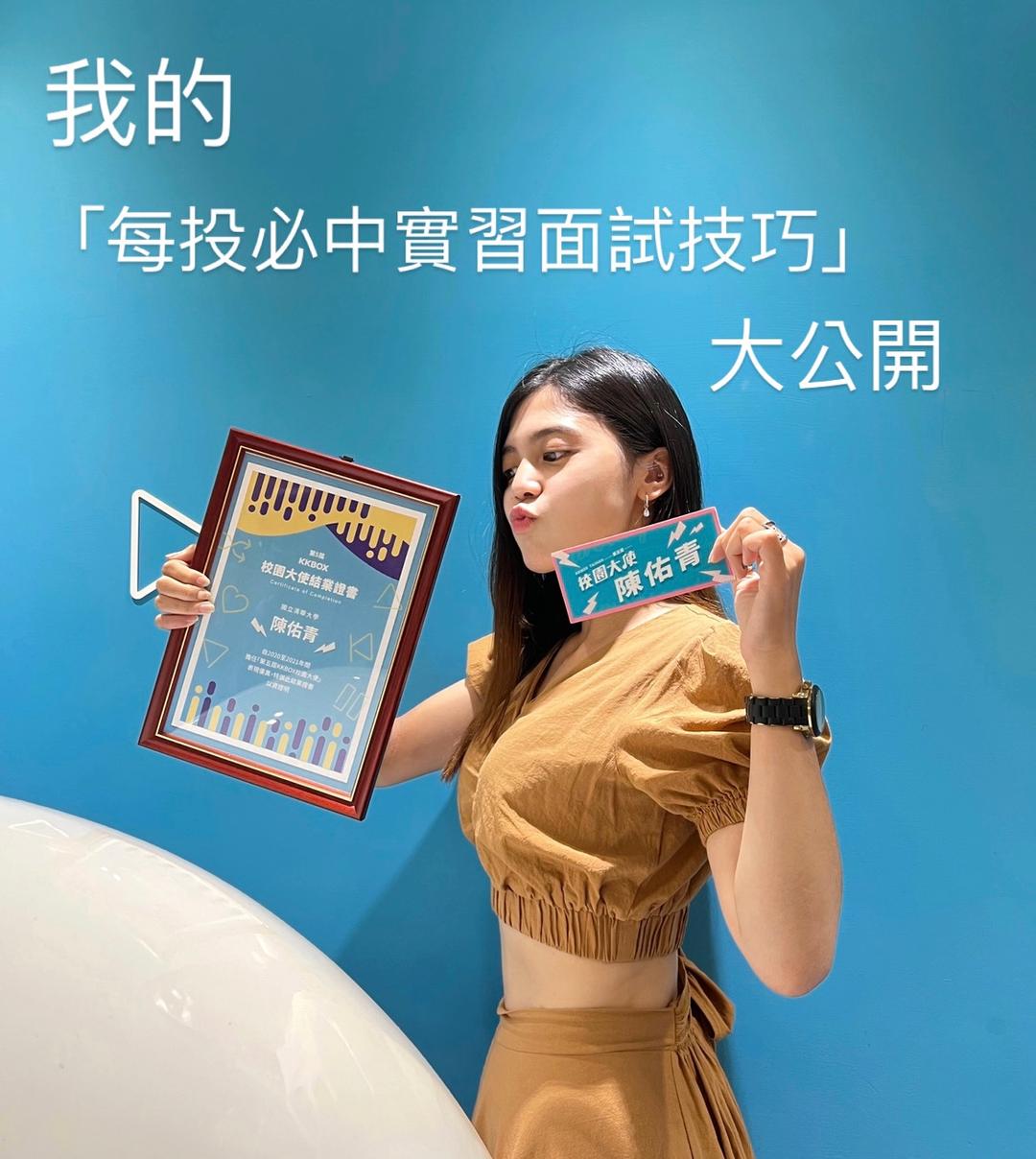
📍“About me” when I made the video
At the time I was a junior at National Tsing Hua University, majoring in educational technology with a minor in information and communication media. Because I loved the media field, I tried as many internships as I could outside class, including: KKBOX's 5th campus ambassador cohort, digital editor at the fashion center of ETtoday (EBC's news site), and intern at POPRadio Taipei. I also worked as a partner lecturer for National Tsing Hua University's Center for General Education, sharing my industry experience and hands-on work.
📍Your resume is your first impression
The first stop in sharing interview tips is, of course, the resume. To get a ticket to the interview, you first have to pass the “paper screening.” Here's my Chinese resume for reference.
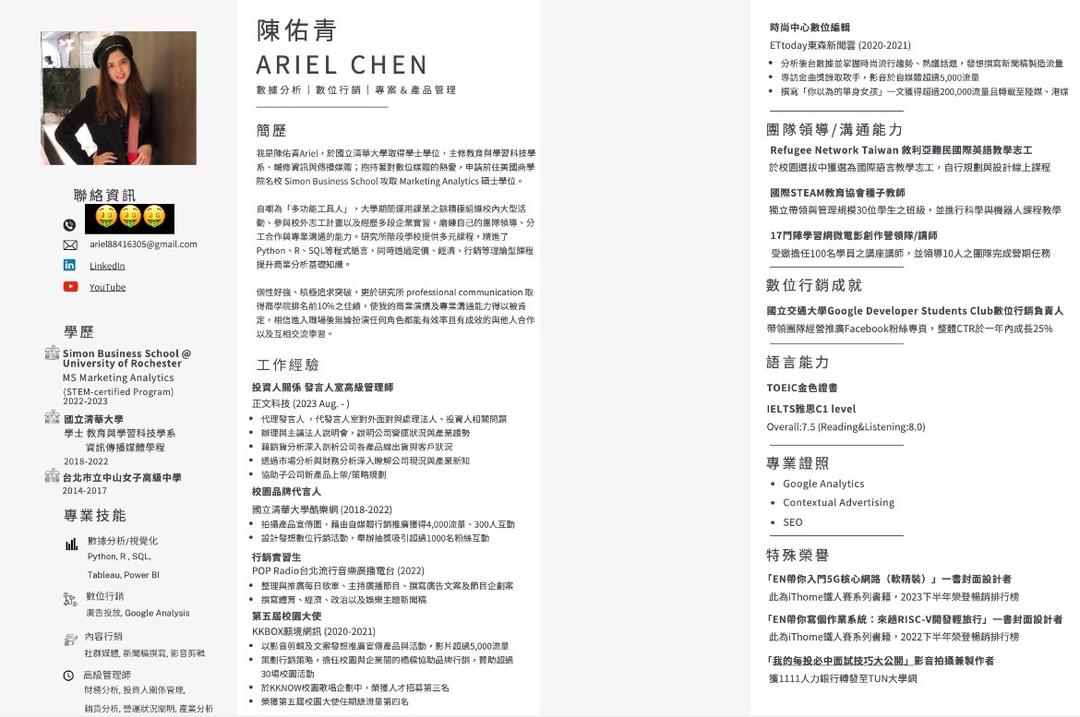
You may have heard that “a resume shouldn't go over one page,” but from my own experience, I don't think it's a big deal. If one sheet of A4 really can't hold how great you are, why not give yourself a bit more room to show it? Still, try to put only the highlights on your resume, and leave out the filler experiences that just take up space.
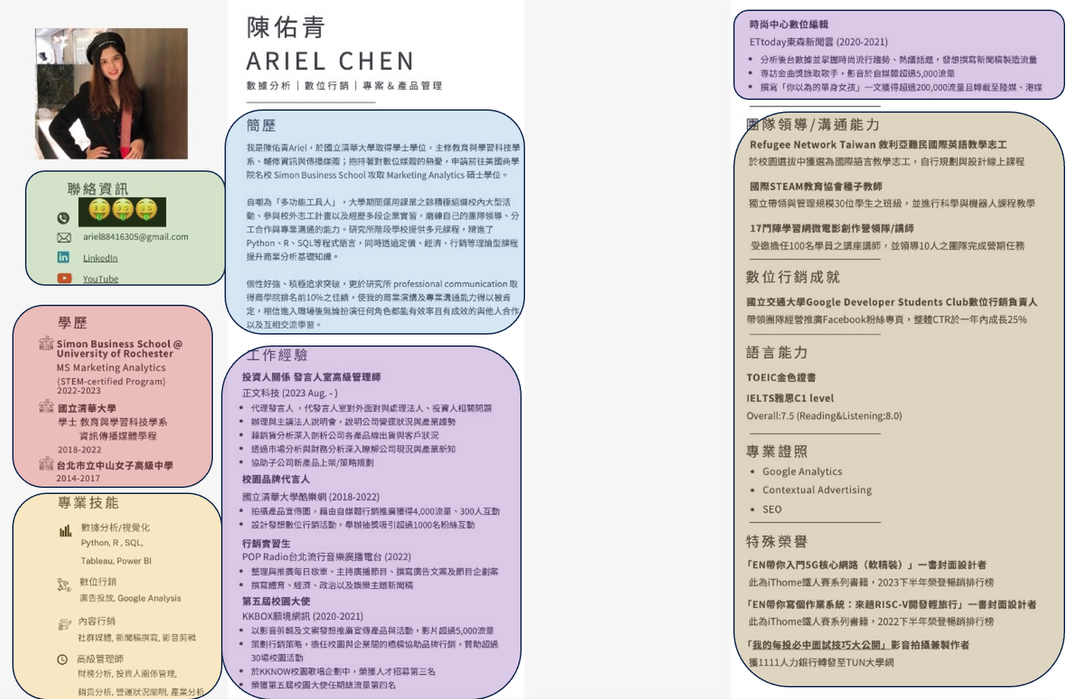
Below I've split my resume into six simple parts: contact information (green), education (red), skills (orange), summary (blue), work experience (purple), and other (brown).
📝Contact information
Here I listed my phone, email, LinkedIn and YouTube, with hyperlinks for the last two so interviewers can click straight through. Also, since I was applying for digital marketing and media roles, including YouTube worked a bit like a portfolio: it keeps reviewers from pegging you as a blank slate with 0 experience at first glance, and shows them that even without industry experience, you've experimented on your own media platform and built up plenty of work on your own.
📝Education
Usually you list your highest and second-highest degrees. Whether to include high school is up to you, but if you went to an elite high school that people will recognize, there's no harm in adding it. Also, while preparing for an interview, besides finding ways to build a link between “me and this position,” I look into the background of the company's founder or the manager first. If they went to the same school as you, 99.99999% they'll be especially interested in you and remember you.
📝Skills
This section lets people who can't be bothered to read your resume get the key points fast, so I suggest boiling your strengths down to 3–4 items in a bulleted list. Beyond that, the most important thing is to “list in detail” your expertise under those 3 to 4 items. For example, if I have “data analysis/data visualization” skills, I'll go on to show underneath that what I know is “Python, R, SQL, Tableau,” and so on.
📝Summary
Unlike “Skills,” which people can take in quickly, the “Summary” is for the “super patient” readers who want to know you better through one or two short paragraphs about yourself. In those two or so paragraphs, I cover who I am, where I graduated from, what my hard skills are and what my soft skills are, and I make sure to weave in examples of related experience to prove you really do have a background in the field.
The rule for writing a summary is simple: it adds little on its own, but it's a shame to leave it out. Never put a crucial skill or experience “only” in the summary, because impatient readers skip blocks of text like this. But you can string your important keywords together into these two paragraphs, so that scattered across the resume each one is a star, and gathered together they shine even brighter.
📝Work experience
Internships and full-time jobs can both go here. My simple template is “Company name - Job title - Dates,” and the most important part is to list your duties as bullet points underneath. As I wrote in “What Does a Cover Letter Template with a 70%+ Reply Rate Look Like? Turn BS into Magic in Five Minutes and Land Interview Invites,” you should quantify your work performance as much as possible. That means: please don't just write things like “I'm great at digital marketing” or “In this job I ran the fan page.” You can make it far more convincing: “Using Google Analytics, which I know well, I grew the fan page's followers by 30% and traffic by 55% in six months.”
📝Other
“Other” covers smaller skills and experiences, for example team leadership/communication (I include clubs, volunteering and camps here), or hard skills such as professional certifications and language certificates. If you also make time for off-campus competitions or activities, you can add those awards and achievements too.
📍Once you've got your interview ticket
Interview questions come in every shape, and you can't prepare a full set of answers to everything before going into battle. So make sure you prepare your “self-introduction,” the most important part, which decides 50% of the outcome. A self-introduction is like a first impression when making friends: a good opening is what lets you win in style.
If you made your resume yourself and wrote your summary and cover letter in your own words, you don't need to worry about the self-introduction at all. It's basically that storytelling SOP: “Who are you? Where did you graduate from? What have you done? Why did you choose this company/this position?” After writing it out two or three times already, you'll handle the self-introduction with ease; you just need to say it out loud.
The golden rule of a self-introduction is “showing confidence.” No matter how nervous you are or how much the competition scares you, you must never show any doubt or anxiety, because your uncertainty shows right on your face and in the conversation. My friends all think I'm a very confident person, but it's actually the opposite: because I dream big, I worry more about winning and losing and doubt myself more easily, and the more that happens, the more I have to “pretend” to be confident in interviews. As the saying goes, if even the melon seller won't praise his own melons, who's going to believe they're big and sweet?
Another big no-no is a mismatch between your “resume” and your “interview.” Remember what you wrote on your resume and don't exaggerate during the interview, because most interviewers skim your resume first. If you wrote things with nothing to back them up and then get asked about them in detail, it gets really awkward. On the flip side, interviewers will remember the parts of your resume that interest them, and if they happen to bring one up and want more detail, that's a bonus question handed to you.
📍Build “person-to-person connections”
In my experience, my secret interview weapon is “constantly building person-to-person connections.”
I don't just say whatever comes to mind because the interview is long, and I definitely don't go through my resume aimlessly with no logic. Instead, I treat every word in the interview as precious, and every sentence I say is meant to connect me as much as possible with “the company,” or with “the position” and “the field.”
By the end of the interview process, it's no longer about whether your skills are good enough; it's about whether your traits are a fit. So in that short half hour to an hour, build as many connections between yourself and “them” as you can, and let the interviewer know you're the only one they want. Even if your skills or background can't be tied to them directly, you can use the chance to explain that you love learning across fields and enjoy growing through trying things.
After one group interview, the interviewer shared that many people speed up without realizing it when they're nervous, but once you talk fast, your mind may go blank in an instant, and the next second you may be lost for words. That vicious cycle only makes you more nervous. I'd suggest slowing your speech a little in interviews to give yourself more time to think and respond.
Every question an interviewer asks will make you take a hard look at yourself in the moment and quickly rehearse an answer in your head. It also shows you what you can still work on after the interview. You may panic the first time, but with preparation and practice over time, one day your confidence won't be an act anymore!
For any questions or suggestions, feel free to reach me on LinkedIn or Instagram💌 You're also welcome to subscribe to my Medium, where I'm still posting new articles!

陳毅_7e74a
Jan 8, 2024
支持!
Ariel 陳佑青
Jan 16, 2024
thank u😻

Jin Cathy
Jan 12, 2024
這篇文章乾貨也太多!想問問學姊當初是用什麼做履歷的
Ariel 陳佑青
Jan 16, 2024
推Canva 免費版就夠用!🫶🏻
茹
Jan 12, 2024
想問問 Ariel 如果求職的話,線上課程應該放在 CV 的哪部分
Ariel 陳佑青
Jan 16, 2024
是指有線上授課經驗的影片嗎? 如果是影音資源我會放在 1.第一面左上角「聯絡資訊」的欄位 然後看你是透過什麼平台上傳影片 可以超連結上去履歷 2.或是放在背面的「其他」區域 可以新增一個類似作品集的區域來呈現 以上是我個人的想法,供參!