Translated by OfferLand from the original Traditional Chinese post. View original

小歐特派員
Updated Aug 11, 2024
TOEFL vs. IELTS: which is harder? - 珍奶闆娘
This article is republished with permission from 珍奶闆娘英文|TOEIC, IELTS and GEPT learning. You're welcome to visit her blog for more great articles!
"TOEFL vs. IELTS: which is harder?" This is a question many English learners ask when choosing a test.
As an English teacher who has scored 8.0 on IELTS twice,
after getting to know TOEFL, I found that how hard the two tests are can actually be judged from these angles:
1. Vocabulary difficulty
IELTS and TOEFL have different vocabulary demands:
IELTS focuses more on common words in everyday, social and academic settings,
while TOEFL often expects test takers to know more specialized, academic words.
So if you're good with the specialized vocabulary of academic texts, TOEFL may suit you better.
2. Background knowledge
TOEFL content often draws on knowledge from many fields such as science, history and sociology,
which means test takers need fairly broad background knowledge.
IELTS, by contrast, tests more how well you use English in everyday and social situations.
In short, which test is harder really depends on your own strengths and habits.
Below is a comparison of TOEFL and IELTS test times
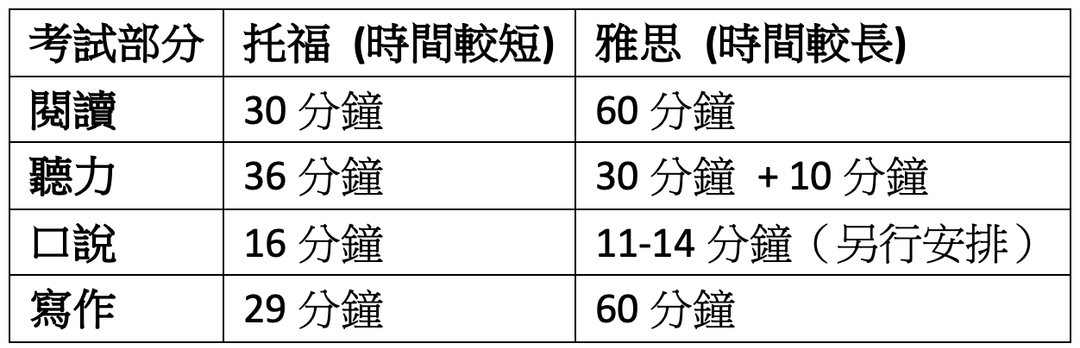
TOEFL total time: under 2 hours
IELTS total time: about 2 hours 40 minutes for the written test + speaking scheduled separately
*Note: timing may differ between the computer-based and paper-based tests.
TOEFL vs. IELTS: which test suits you better?
When choosing an English proficiency test, it's important to know your learning style and strengths. Here's the style of each test, TOEFL and IELTS:
TOEFL
Students with broad knowledge and a large specialized vocabulary
If you often watch popular-science shows (geography, biology and so on), you'll find it easier
If you're good at connecting knowledge across fields, for example writing an essay on "comparing political systems," while also handling science topics
You can pick the answer even without hints from the passage, but unfamiliar fields like astronomy or earth science will be harder
IELTS
Students who are good at reading strategies and logical judgment
IELTS doesn't stress memorizing technical terms; it values the ability to work out meaning from context
Many question types that test how flexibly you respond, such as (True/False/Not Given) or matching headings to paragraphs
In speaking and writing, IELTS may ask you to take a position on a topic and answer using what you already know
TOEFL vs. IELTS: how should you prepare to do well?
An effective prep strategy is the key to success. Here are some prep tips for each test:
TOEFL
Some questions point directly to the part of the passage where the answer is, which makes finding it easier.
Use resources like TED-Ed whose topics overlap a lot with TOEFL to build your vocabulary and related knowledge.
IELTS
The test often involves "paraphrasing," so you need to be able to spot "synonyms" and "key sentences."
Work on recognizing synonyms and practice picking out key sentence patterns quickly.
Summary:
TOEFL and IELTS passages are academic and fairly long, so you need to prepare well, especially getting familiar with high-frequency vocabulary and complex sentence structures. Prepare thoroughly and know the question types, and you'll perform at your best on test day.