Translated by OfferLand from the original Traditional Chinese post. View original

Wordvice Taiwan
Updated Mar 11, 2024
How to Write a Statement of Purpose (SOP) for Graduate School Abroad
When applying to graduate school, applicants need to prepare many documents, including letters of recommendation, a résumé (CV), a personal statement or autobiography (Personal Statement) and, most important of all, the Statement of Purpose (SOP).
Why is the SOP so important in a grad school application, and how is its format different from an undergraduate application essay? Read on to find out.
An introduction to the Statement of Purpose (SOP)
How a graduate SOP differs from an undergraduate application essay
The biggest difference between a graduate SOP and an undergraduate application essay is professional experience. Graduate applicants have more background and experience that can set them apart and help them stand out. In scope (breadth of content) and detail (depth of content), a graduate SOP is far more complex than an undergraduate application.
Take MBA (Master of Business Administration) programs as an example: applicants usually have several years of work experience, so they can write about that experience in their SOP to strengthen it.
Further reading: How to write a successful MBA application essay
Why do grad school applications require a Statement of Purpose?
The Statement of Purpose is the most important part of a graduate application. It gives applicants a chance to show the admissions committee qualities that can’t be measured by scores alone, including personal strengths, professional strengths, career ambitions or a strong interest in certain subjects. Of course, you also need to show the department you’re applying to that you’re strongly motivated to attend, and explain how you and the department can benefit each other.
SOP format
How long should an SOP be?
An SOP should usually be between 500 and 1,000 words and no longer than one page, but it depends on the school or department you’re applying to and on how much academic experience you have.
SOP formatting rules
Unlike the format of undergraduate application essays abroad, a graduate SOP is usually not typed into a text box on an application platform like ordinary application materials.
Instead, most graduate applications are uploaded directly to the department, usually as a Word file or PDF.
Other SOP writing principles
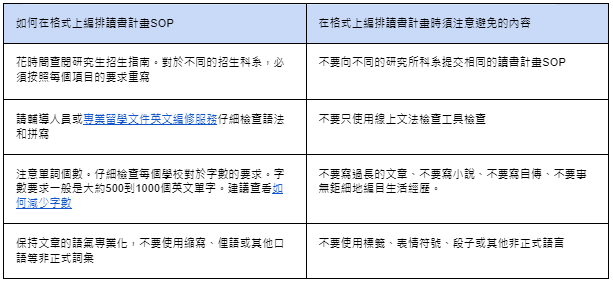
Check and revise. Make sure your SOP has no errors, including spelling and grammar mistakes
👉🏻You can also use a professional English editing service for study-abroad documents such as the SOP to prepare your application materials more efficiently
Write in a clear, concise style
Avoid clichés and repetition
Avoid casual, conversational language, including emoji and hashtags
Don’t make it too long, and remember to use paragraphs
Further reading:
SOP structure
A persuasive SOP usually has a clear structure, which makes it easier for readers to follow and also holds their interest.
Although a graduate SOP is more complex than an undergraduate application, it’s largely similar to the structure of an undergraduate application essay.
Introduction: state your goals and introduce yourself
The introduction of your SOP should clearly explain what you hope to achieve by completing the degree.
For example:
For a history student, the goal might be to earn a PhD so they can work as a historian at a major nonprofit or museum after graduating
For a chemistry student, the goal might be to do postdoctoral research at a research university after graduating, with the hope of becoming a professor later
Some applicants may also hope to work in the private sector after graduating. In any field, the introduction should cover your professional background, academic background, internships or work experience, and your career goals.
📌Tips:
Grab the reader’s attention with your first sentence: consider opening with an anecdote, an allusion or quote, or a gripping story
Set things up: the second half of the introduction should briefly preview the rest of your SOP
Body 1: academic background and professional experience
In the first part of the body, you need to describe your academic background and professional experience in detail, along with projects you’ve completed, work achievements, learning experiences and so on.
Start with a brief overview of your undergraduate studies and grades, then describe extracurricular activities, professional experience and career achievements.
Your professional background and work experience will usually be much richer than an undergraduate applicant’s, and these experiences can help you stand out.
Emphasize your studies and grades as needed.
Explain how you made good use of your university’s resources, and whether you built good relationships with professors. These are qualities PhD advisors pay particular attention to.
📌Tips:
Show interest in the department: explain why you’re interested in this graduate program.
Define your academic goals: as a graduate student, you’ll begin doing research in your field. So say which feasible research goals you hope to achieve.
Define your career goals: write what work you plan to do after grad school, including your career goals in academia or industry.
Assess your strengths and weaknesses: describe them and how they developed. Use self-awareness to show how your actions and personality influence others. Teamwork and fairness are very important admissions considerations.
Write it as an essay, not a bullet-point résumé. Weave your achievements and experiences into an engaging story instead of a dull chronological list.
Use examples: flesh out the content with persuasive examples, the more specific the better. For example, if you’re applying to a statistics-related program, you could describe the moment weighted expected value suddenly clicked for you while playing poker with your grandpa.
Body 2: explain why you’re the perfect candidate
When the admissions committee considers you, your goals and interests must align with the school’s mission and values. So use this section to write something memorable that shows your in-depth knowledge of the school and department, and tie that understanding closely to your academic goals. Try describing what you know about a few of the department’s professors, or the achievements of distinguished alumni you admire, to show you’ve researched the department carefully.
📌Tips:
Match what the department is looking for: read the school’s graduate admissions guide closely, make sure your SOP fits the department’s admissions needs, and pay attention to personal experiences in it that relate to the department.
Fit the community and culture: today’s universities look for students who can represent the department’s community and contribute to it. Consider how your background and goals fit into the city, university and culture where the department is located.
Learn and benefit during your studies: once you get an offer, you’ll be investing time, money and energy in academic research. The admissions committee wants to know what you expect to gain from your studies, so you can describe what you know about the faculty’s academic work to show related interests and academic expectations.
Conclusion and summary
The conclusion of your SOP needs to do two things:
Sum up everything above
Make the reader want to learn more about you
Here you can sum up what earning a master’s/PhD means for your professional development and personal growth, and write about the impact you’ll have on your field as well as the impact the degree will have on you.
📌Tips:
Keep it concise: the conclusion usually doesn’t include new content, but don’t repeat too much either.
Restate your value: you are your own best advocate. Show confidence in your abilities and firm conviction in your application. What you bring to the department is a unique academic background, professional experience, personal story and set of goals.
Even if you aren’t admitted, it’s just because your background wasn’t the right fit. Don’t let a poorly written SOP cause your value to be underestimated or misunderstood!
Further reading: How to write an excellent Personal Statement?
【OfferLand Exclusive Partner – Wordvice English Editing】Making sure your English study-abroad application documents are right
Leave your study-abroad documents to us with confidence. Just click the link to use our English editing service or Chinese-to-English translation service and get 10% off your first order~
Make the most of this before your application deadlines💪🏻