Translated by OfferLand from the original Traditional Chinese post. View original

小歐特派員
Updated Jul 29, 2024
PhD Application Experience | From Applying Straight to a US PhD to Buying a Home in the US
About me
Hi everyone, I'm Angus, a Physics Ph.D. student in my 3rd year at NEU. My research focuses on Machine Learning/Condensed Matter/Quantum Computing. I went straight into a PhD after a bachelor's in physics at National Chung Hsing University. I got offers from three schools, UT Austin and Stanford among them, and chose NEU in the end. Feel free to hit me up for a game of ball, skiing, or a coffee chat.
1. Why I applied abroad & what it's been like
Why study abroad?
When did you decide or plan to study abroad and pursue a PhD in physics?
Originally I wanted to do a CS master's abroad so it'd be easier to find a software job back in Taiwan. While preparing application materials in my sophomore year, I discovered a great intersection between physics and computer science: Quantum computing. In my junior and senior years, after joining a lab, I learned more about the field. Later I realized you don't need a CS degree to build coding skills; physics actually involves more and harder coding. So in the end I chose to go straight for a PhD.
Did you consider continuing your studies in Taiwan? What ultimately made you decide to do a PhD abroad?
I did consider finishing a master's in Taiwan and then applying for a PhD overseas, which is also what the professors writing my recommendation letters suggested (they didn't even think I was qualified to get into a Ph.D.). After doing my homework carefully, I found that for applications, master's and PhD programs ask for the same things, so I figured I'd treat it like a lottery ticket and give it a shot. But the SOP takes more effort: you have to sell the prospects you see, why you need a Ph.D., and the resources/labs this particular school offers. So my strategy was to apply mostly to Ph.D. programs, with CS for a few safety schools.
Why Northeastern's PhD Program?
What did you consider when choosing schools to apply to?
As I recall, I opened US News, split the rankings into bands of 10 down to roughly 100 overall, and picked 1~2 schools from each band for my first-round list. Then I clicked into each one to look at the department details, lab resources, well-known Condensed Matter faculty and so on. In the end I applied to 15 schools for a Ph.D. and 3 more for a Master in CS.
In your admission results shared on OfferLand, I saw you were also admitted to Stanford and UT Austin. What were your main reasons for choosing NEU?
From Stanford I got a conditional offer that required me to take make-up credits. That meant at least three years of study, and only for a Master degree. Running the numbers, I found I might spend NT$4~6 million (assuming at most NT$2 million a year) on a master's.
The issue with UT Austin was its advisor system: you had to find a matching professor beforehand instead of finding one after you arrive. Unluckily, both professors I wanted were full, and I would have had to wait a year for an opening. So I chose NEU first and considered transferring to UT Austin later.
NEU's package was the best that year: a 45000 stipend per year + full tuition waiver + health insurance. Factoring in opportunity cost, there was little chance I'd pass on NEU for Stanford, especially since Stanford would only give me a Master while NEU is a Ph.D.
You've been doing your PhD at NEU for a while now. Has your actual experience matched your original expectations?
As a physics PhD student at NEU, do you feel the research life and resources here are helping you reach your original academic goals and plans?
There really are a lot of resources, but you need to find the right advisor. During lab rotations I switched between two labs, and neither had much money/resources, so I had to teach (TA) while doing research, which was very inefficient. Since moving to my current advisor I've had plenty of resources and can focus on research. NEU's advantage is its location: it collaborates closely with MIT and Harvard, though of course that depends more on your advisor.
2. Preparing my applications
Which application documents did you prepare?
Could you share your process and timeline for applying to NEU? When did you start preparing your application documents?
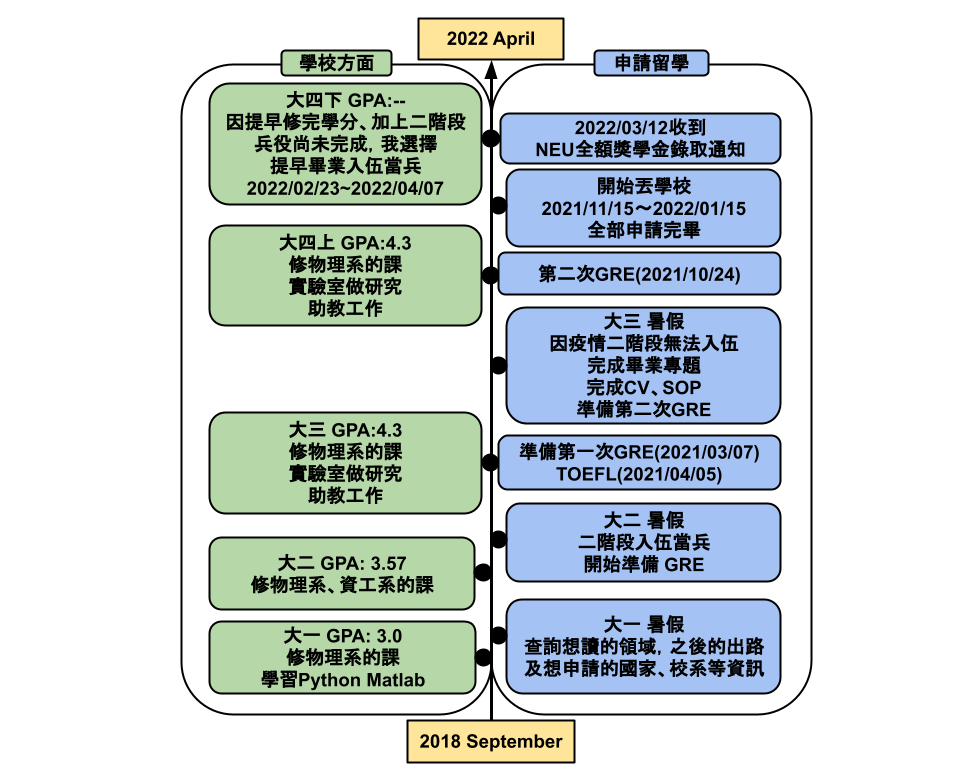
I submitted my applications in the fall of senior year, so I started preparing intensively in the summer before junior year. The documents needed were the TOEFL, GRE, CV, SOP, transcripts and three recommendation letters. I think my medium post covers this in more detail, so take a look
Figure 1. Application timeline (from Medium)
GRE/TOEFL
Before preparing for these two tests, I spent a day doing one practice test of each to test the waters. The GRE turned out to be far harder than the TOEFL, so I decided to prepare for the GRE first, figuring it would be like walking downstairs afterward. I prepared for both during the semester: I started in the 2021 winter break, and had both tests done by the time the Dragon Boat Festival long weekend was over after the new semester began.
GRE
I took it twice. The first time was on 2021/03/07, and I got the VQVQV order: V:145, Q:170. I forget my writing score; it doesn't matter much for STEM applications. I thought 315 was good enough to start applying to some schools. After a week off, on 03/13 I moved on to preparing for the TOEFL.
The second time was right before applying, on 2021/10/24. I got QVQVQ: V: 161, Q: 170, 331 total. I took it again because after my first attempt, I discussed it with my study-abroad agency and we thought I could try for some higher-ranked schools if I raised my GRE. So after finishing the TOEFL I came back to GRE prep. This time, though, I didn't use 考满分 (Kaomanfen) but realistic mock test software bought on Taobao, about NT$800~900 a set as I recall. Almost all the questions are real past questions. I went through every question once, and on test day I got two reading passages that were exactly the same, so I answered every question instantly. I have to admit that V: 161 is mostly padding, not real skill.
TOEFL
After my first practice test I had R: 28, L: 28. My goal was just to break 100, since most schools I wanted had a TOEFL cutoff around 100. With six or seven months left before applications, I figured testing early meant more chances to retake, so I signed up for the TOEFL on 2021/04/05. For those three weeks I prepared Reading & Listening with the 考满分 website, doing two full tests a day plus review. A typical day: wake up and memorize vocab, go to class, come back and do two tests, memorize vocab before bed, repeated for three weeks straight. For writing, if nobody can mark your essays for you, try the site below (link); it grades automatically. I wrote lots of essays using templates and usually scored 24~25, and my actual score did come out at 24. For speaking I used the 考满分 phone app, but I practiced it much less and prepared in a rush, so I only got 22 in speaking.
Recommendation letters
Since most STEM master's and PhD programs require three recommendation letters, I chose to join a lab. I knew the PI had a bad reputation, but his field matched what I wanted to do, and there was a chance to publish a paper. (I did end up getting the letter, but the paper looks like it'll never happen.)
For the other two, I was a TA for two freshman general physics lecture courses and one computational physics course, mainly teaching Python. I wrote the teaching materials in MarkDown as .html files and posted them on the school platform for students. Two letters, got 'em!
To sum up, my three letters came from:
One from my lab's professor
One from the professor who taught general physics to the chemistry department
One from the professor who taught general physics to the EECS department
All three professors sent their letters directly to the schools, so I never saw the content. I only gave them the teaching materials I made as a TA, my CV and my SOP. Remember to stay in close contact with your professors: they really are busy, and they really will forget to send your letters….
I used a plain-text template on overleaf. Personally I think a CV made with LaTeX gives you more layout freedom and nicer fonts. Of course, I also borrowed from lots of other people's CVs before arriving at this version.
For the SOP, the first paragraph opened with my motivation for applying to the Program, my journey, and the inspiration I got from a professor's talk on Quantum Computing. The second paragraph put a positive spin on my terrible freshman GPA. The third paragraph was the turning point: why my GPA went up, why I took CS courses, what effort I made and what changed. The fourth paragraph was tailored to what's unique about each school's Program. The last paragraph covered my outlook and my research and study plans once in the Program. This part is fairly long, so if you're interested, get in touch and I'm happy to share my template for reference.
You received a full scholarship from NEU. How did you apply for it? What do you think helps in getting a scholarship?
A Ph.D. comes with funding automatically; you don't apply for it. So I don't have any experience to share, sorry. But I know that for a master's, a scholarship is almost impossible. US scholarships really do look at ethnic background and minority status. Trust me, we don't count as any minority…
What challenges or setbacks did you face during preparation?
As a Taiwanese college student applying abroad, did you run into any cultural differences or institutional barriers? How did you deal with them?
It felt fine to me. I believe most Taiwanese students won't really run into problems. Taiwanese people are crazy and open-minded enough, and very willing to embrace cultural differences.
Did you hit any roadblocks writing your SOP, CV and other application documents? How did you solve them?
The biggest problem with my SOP was that I needed to put a positive spin on my awful freshman grades (I nearly failed several courses). Luckily I turned things around from sophomore through senior year. So the way I wrote it was that as a freshman I was still searching for my career goal. My example was that back then I only wanted to write code, and most freshman physics courses are mathematical derivations, so I wasn't very interested. But once I found Quantum computing, I realized my coding skills could keep up while my Physics couldn't. So I started putting much more effort into my coursework, which is why my grades differed so much later.
3. How my experiences helped my application
How do you think your research experience at National Chung Hsing University helped your application?
What did you do while in school (courses, competitions, etc.) to prepare for applying?
Mainly research. Doing a project makes you more familiar with the field; you force yourself to read more papers and learn the skills you want. Nobody will teach you these things abroad either. Nobody teaches you how to read this stuff; you have to figure it out yourself. But once you've figured things out and summarized them, you'll have plenty to write about in your application documents.
Besides research, did you take part in other extracurriculars or win any awards in college? If so, how did they help your application?
In college I just played on the department basketball team. It's good to have some kind of pastime outside work/study, somewhere to blow off stress.
Do applicants without a related background stand a chance?
What advice do you have for students outside physics-related majors to improve their chances? How should they start preparing?
Physics covers a lot of ground, so applicants without a related background definitely have a chance, but they'll have to put in more effort. It's hard for me to come up with a general rule for anyone. If you really want to go down this path, I'd suggest a coffee chat with me haha
Could you share some valuable lessons for younger students hoping to pursue a PhD in physics?
Pick a field, and don't think you understand physics just because you know a few buzz words. Go to lots of seminars and talk with senior researchers. Physics is so deep and broad that the era of working alone is over; everyone collaborates now.
4. Buying a home in the US
Why did you decide to buy a home? How did you put together the funds?
Anyone in Boston knows rents here are ridiculously high: a 1 Bedroom 1 Bathroom starts at US$2800 at least. Sharing with roommates averages around US$1300~1500. I'll be here at least five years, which means I'd pay a landlord US$80000, close to a down payment on a home. Take the unit I bought as an example: 2B2B, a 15-minute drive to downtown Boston, US$500,000. After buying it I rented out the other 1B1B, so the mortgage I pay is effectively paid to myself, with a roommate chipping in. Even if I sell after five years, I won't lose money. How I put the funds together is fairly private; in short, I transferred the money over from Taiwan in installments. If you're really interested, come chat with me.
Did you need a real estate agent? Is it easy for foreigners to buy property?
You must have a buyer's agent; there's a lot of paper work we can't handle ourselves and that needs someone with a real estate license. Foreigners buying homes in the US, especially NRAs, make up a very high share, and most pay cash, because US interest rates are frighteningly high. I took out a loan in Taiwan and brought it over to buy the home. As I recall, when I got a quote, my rate would have been around 7%. You don't pay the agent's fee; the seller pays it (4% in total, 2% for seller agent, and 2% for buyer agent)
Do you worry that after buying, visa or status issues might keep you from staying in the US long term?
Worst case, you sell the house. Since it's owner-occupied and held for more than two years, I recall there's a tax exemption for a certain amount of the gain; pay whatever tax is left and go back to Taiwan. Boston real estate is relatively stable, and there are plenty of international students. If you know a real estate agent well, you can have them handle renting and managing it for you, no problem.
5. OfferLand's Mantou mentorship program
Why did you join the Mantou program as a mentor?
To keep the people coming after me from taking wrong turns, and to give more information to others who also want to apply for a Physics Ph.D.
As a mentor, how do you hope to help your mentees? Anything you'd like to share?
When you're applying there are lots of questions you need to talk through with someone. I think you should do some homework and get organized first, then come to your mentor. When I had coffee chats with a few mentees, what struck me most was when someone came without doing any homework: they didn't know what to ask, and we just sat there stuck. Of course I want to share my application journey, because I've been down this road and know how hard it is. When I was applying, I also wished I had someone senior to guide me step by step, but back then most people applying for Physics Ph. D. programs didn't put this kind of material online, so there wasn't much information to go on.
Schools in this post
- Stanford University
- University of Texas at Austin (UT Austin)
- Massachusetts Institute of Technology (MIT)
- Harvard University
See each school's applicant numbers, admit rates and past applicants' results

已封鎖用戶-c893d25d
Jun 24
This comment has been deleted