Translated by OfferLand from the original Traditional Chinese post. View original

Sean褚宥澤
May 11
TOEFL
School and major: Chenggong High School
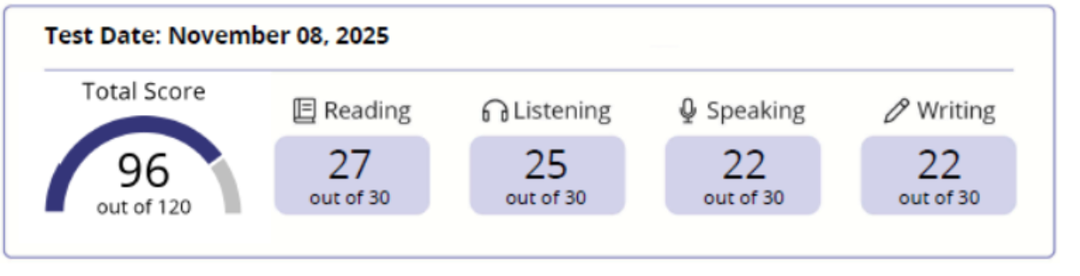
Scores: 1st attempt R25 L26 S23 W21, total 95; 2nd attempt R27 L25 S22 W22, total 96
Test dates: 1st attempt 2025/08/20; 2nd attempt 2025/11/08
[Prep Notes & Approach by Section]
[Reading]
For reading, the core strategy is locating and analyzing structure. With long passages that easily run three or four hundred
words, never read from start to finish; it will drain your focus. I usually look at the key words in the question first, then go
straight back to the passage to find the relevant paragraph. When practicing, I make a point of marking transition words (like However,
Consequently), which helps me quickly grasp the author's attitude. Even when I hit technical words I don't know
, as long as I've grasped the cause-and-effect or contrast between paragraphs, I can still accurately rule out distractors, which greatly speeds up
my answering.
[Listening]
Listening is the soul of the TOEFL, because it runs through the speaking and writing sections that follow. When preparing, intensive listening is
more useful than extensive listening. I stopped insisting on understanding every word and instead practiced catching shifts in tone and the points the professor
emphasizes. For notes, I developed my own system of symbols. This process of turning what I understand
into logical notes means I no longer drift off as easily during five-minute lectures, and I can accurately
predict what will be asked.
[Speaking]
As for speaking, my biggest lesson was that fluency beats everything. Raters don't care how fancy
your rhetoric is; they care whether you sound confident and keep a steady rhythm. For the independent task I prepared five
all-purpose stories, and I used fixed templates for the integrated tasks. Every day I recorded my practice
and listened back to cut filler words (like uh, like). Once you can speak as fluently as if you were telling a story, your score will
naturally reflect it in fluency and coherence.
[Writing]
Finally, writing: the current test format calls for more concise expression. My practice focused on tight
logic and rich detail. In integrated writing, the key is to clearly show how the reading and listening viewpoints
conflict; in the academic discussion task, I practiced putting forward strong arguments and examples quickly. Cutting down on basic
grammar mistakes and making sure every point is backed by concrete data or experience is the key to a high score.
Across the whole test, keeping your output steady and consistent is the surest way to do well.
[Study Plan]
Followed the WordgodAIAgency mentioned here · See profile and reviewsDetected by AI. Not an endorsement by the author or OfferLand. course schedule
[Test Center Report]
The Wordgod test center in the Shoude Building is great and very comfortable; the equipment, the test process and the proctors were all good
[Words of Encouragement for Other Test-Takers]
Good luck
[Score Report]
Agencies in this postAIDetected by AI. Not an endorsement by the author or OfferLand.
Agency mentioned here · See profile and reviews