Translated by OfferLand from the original Traditional Chinese post. View original

OfferLand
Updated Oct 17
Master's Thesis in English: Thesis vs. Dissertation in the US and UK
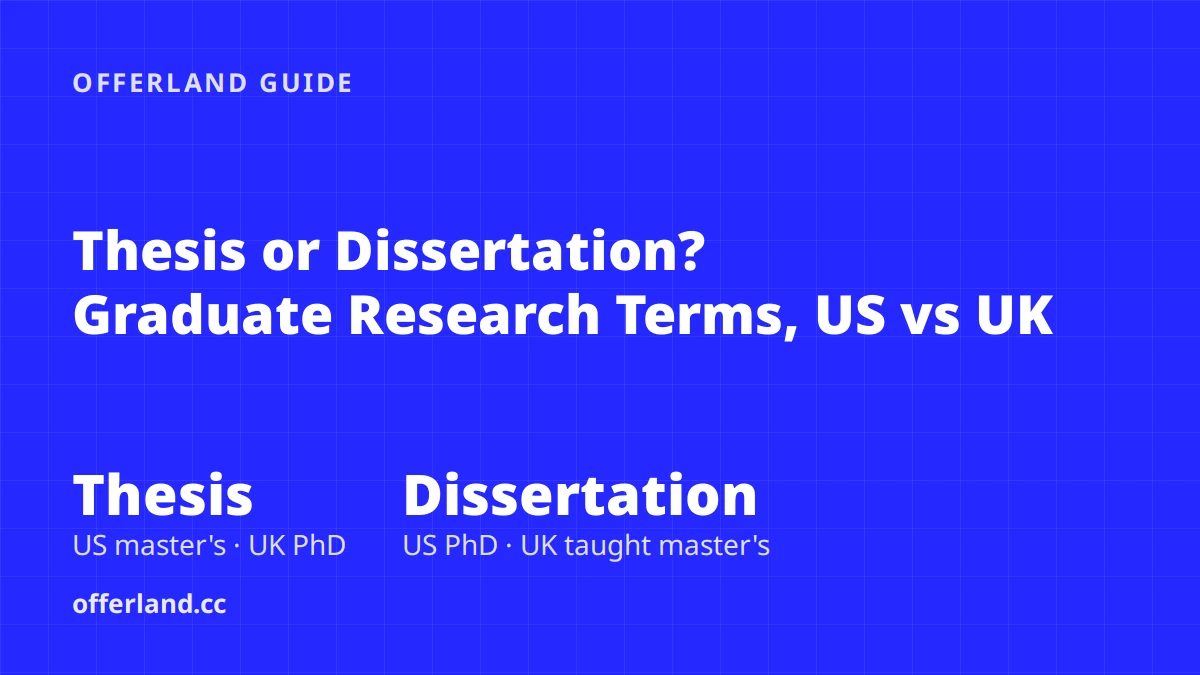
In the US, a 碩士論文 (master's-level thesis) is usually called a master's thesis, and a doctoral one a doctoral dissertation. The UK flips this: students in one-year taught master's programs write a dissertation at the end, PhD students submit a PhD thesis, and the oral exam is called a viva, not a defense. The same word means different things in the two countries, so before you read a program page or a school's rules, check which convention that school follows.
Key points
The common US usage is "master's thesis, doctoral dissertation." Portland State University's Graduate School rules state that master's students completing a thesis and doctoral students completing a dissertation must both take a final oral examination.
In the UK, a doctoral dissertation is called a thesis. Cambridge Engineering caps the PhD thesis at 65,000 words, and Newcastle University's 2026-27 rules limit doctoral theses to 100,000 words in the humanities and social sciences and 80,000 words in science, engineering and medicine.
In UK taught master's programs, the large final project is called a dissertation. The University of Edinburgh Business School's master's in Human Resource Management runs for one year, with the dissertation scheduled over the summer, May to August.
In the UK, the doctoral oral exam is called a viva. Cambridge Engineering says most vivas are run by 2 examiners (usually one internal and one external), with 3 months allowed for minor corrections and 6 months for major ones.
Many US master's programs offer two tracks, thesis and non-thesis. The University of Maryland's physics master's requires 30 credits on either track, and students who choose the thesis track must pass an oral exam.
How US and UK usage differs
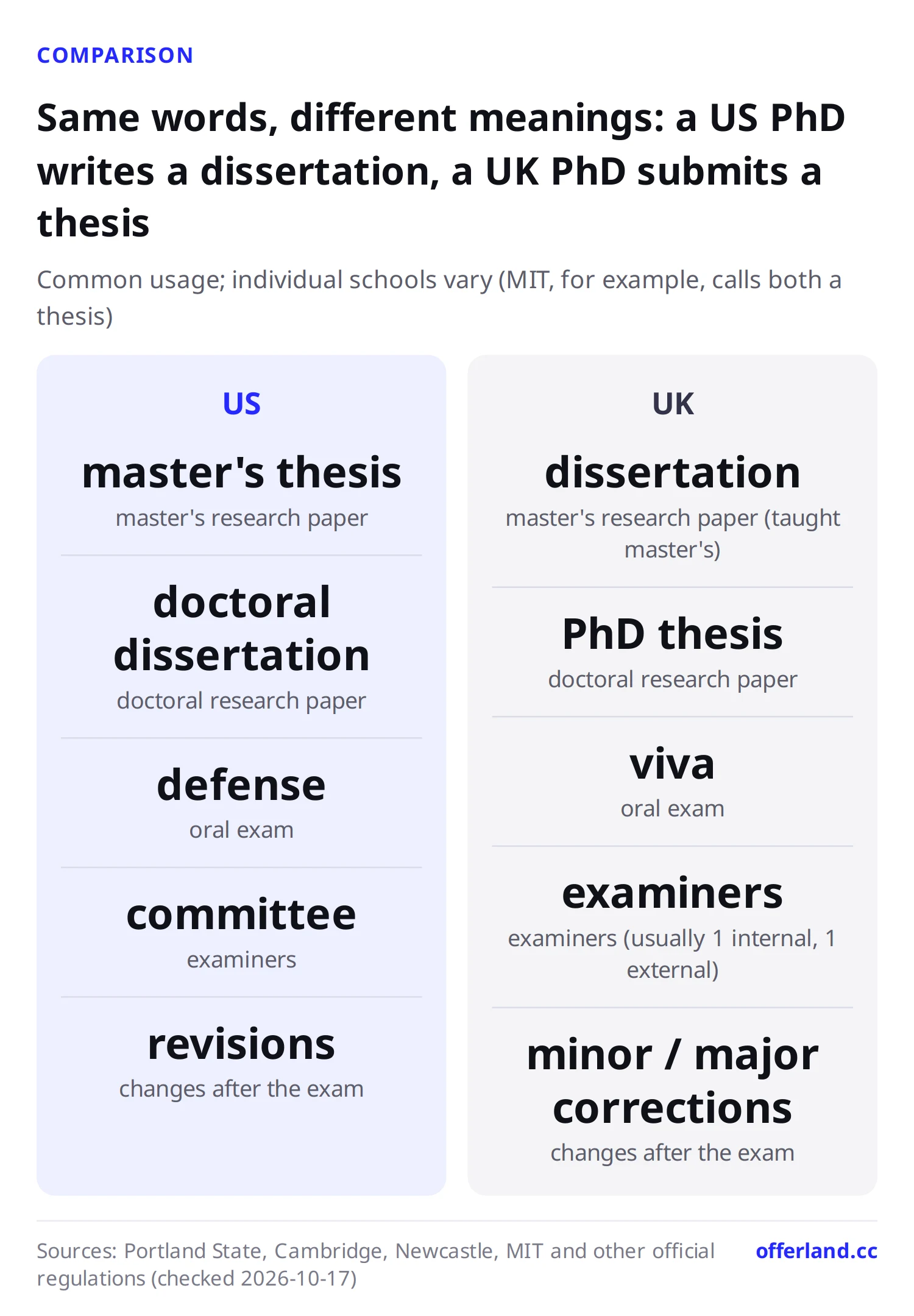
Thesis and dissertation are the easiest to mix up. The table below lists the usual equivalents in each country; individual schools may still have exceptions.
Chinese | Common US term | Common UK term |
|---|---|---|
碩士論文 (master's-level thesis) | master's thesis | dissertation (taught master's); thesis (MPhil, research master's) |
博士論文 (doctoral thesis) | doctoral dissertation | PhD thesis, doctoral thesis |
論文口試 (thesis oral exam) | defense, final oral examination | viva, viva voce |
口試委員 (oral exam panel) | committee | examiners (usually 1 internal, 1 external) |
口試後修改 (changes after the oral exam) | revisions | minor / major corrections |
沒有論文的碩士 (master's without a thesis) | non-thesis option | Taught master's programs usually still have a dissertation or project |
The US has exceptions too. At MIT, for example, graduate school rules call both master's and doctoral work a thesis ("Master's and doctoral theses must be submitted electronically"), so seeing "doctoral thesis" on MIT's website is normal. In the UK, PhD students at the University of Cambridge and the University of Oxford also submit a thesis.
At the master's level, the difference comes from how programs are structured. UK taught master's programs mostly last one year: two terms of classes, then a dissertation written over the final few months. The University of Edinburgh's MSc in Human Resource Management is set up this way. For programs like those at UCL or Imperial College London's MSc in Advanced Mechanical Engineering, check whether the last module on the program page is called a dissertation, an individual project or a research project. Some UK programs also replace the traditional dissertation with a group project or a company project; see UK marketing master's options without a dissertation.
US master's programs, by contrast, often let students choose. In STEM programs such as the University of Michigan's MS in Mechanical Engineering, check when you apply whether you're on the thesis or the coursework (non-thesis) track: the two have different graduation requirements and timelines.
From proposal to defense: English terms for each stage
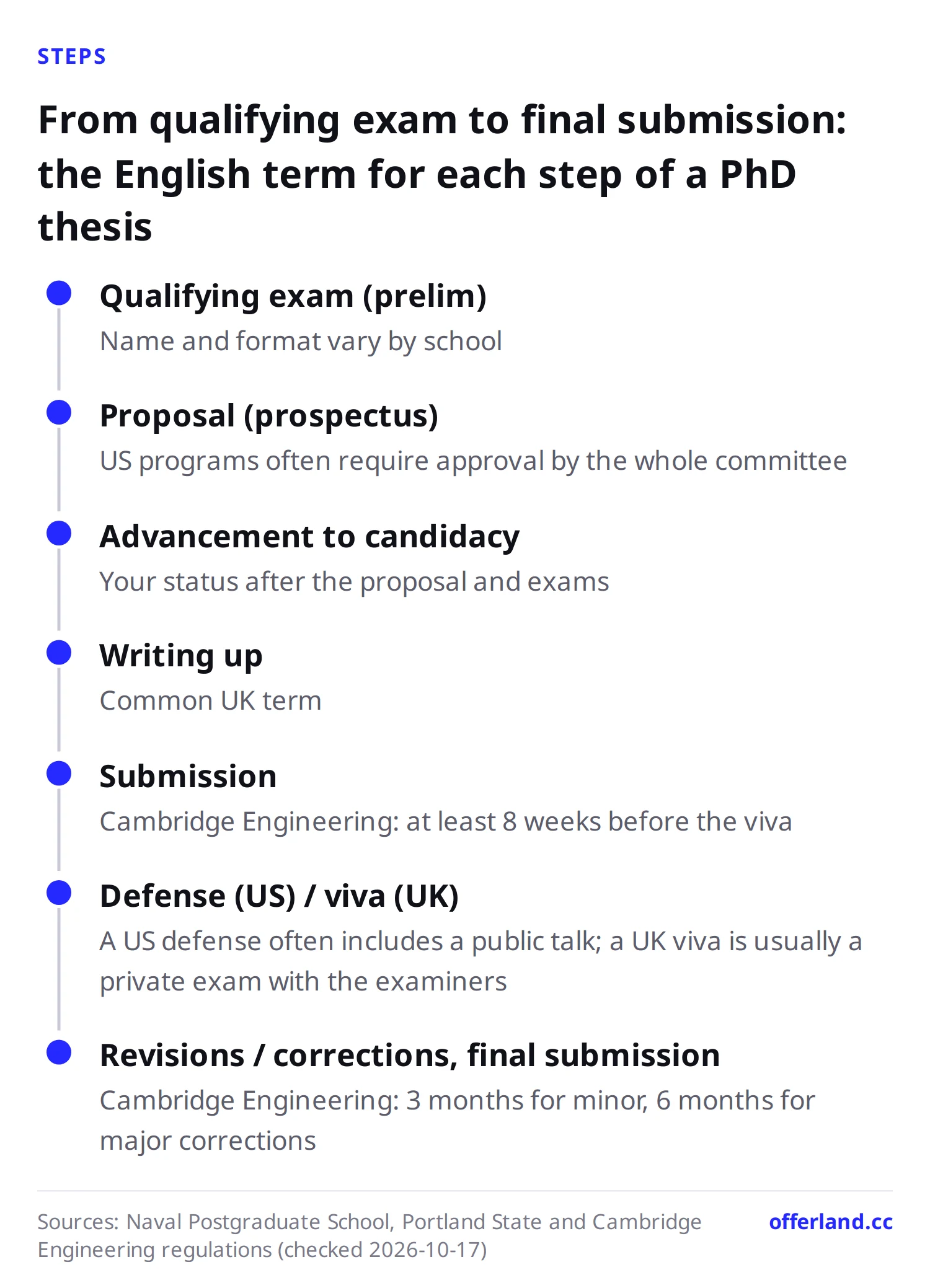
Most US PhD programs follow this sequence: coursework, qualifying exam, research proposal, advancement to doctoral candidacy, writing the dissertation, and the defense. The table below gives the English term for each step in order.
Stage | English term | Notes |
|---|---|---|
資格考 (qualifying exam) | qualifying exam, prelim | Name and format vary by school |
論文計畫書 (thesis proposal) | proposal, prospectus | US PhD programs commonly require approval from the full committee before the student can apply for candidacy |
博士候選人 (doctoral candidate) | candidate, advancement to candidacy | Status after passing the proposal and exams |
撰寫論文 (writing the thesis) | writing up | Common UK phrase |
送交論文 (submitting the thesis) | submission | In the UK, the viva is scheduled only after submission |
口試 (oral exam) | defense / viva | A US defense often includes a public presentation; a UK viva is usually a private discussion between the examiners and the student |
修改後定稿 (final version after changes) | revisions / corrections, final submission | You graduate only once the changes are done |
A few examples of school rules: the Naval Postgraduate School's academic policy states that the doctoral research proposal must be approved by every member of the dissertation committee before the department can apply to advance the student to candidacy. Portland State University opens master's thesis defenses to its faculty and doctoral dissertation defenses to the public, with the student's presentation limited to 60 minutes. On the UK side, Cambridge Engineering notes that the viva won't be scheduled until at least 8 weeks after the thesis is submitted.
When you apply to US PhD programs, pages for programs like Stanford's PhD in Electrical Engineering often mention the qualifying exam and the dissertation defense. Once you know the terms, program rules are much faster to read. For how to write a proposal, see Master's Thesis Proposal Writing Guide (Part 1) and (Part 2).
Chapter terms inside the thesis
Theses and dissertations use largely the same chapter names. The table below lists the words you'll run into most when writing or reading one.
Chinese | English | Notes |
|---|---|---|
摘要 | abstract | Newcastle University limits abstracts of research-degree theses to 300 words |
緒論 | introduction | Research question, motivation |
文獻回顧 | literature review | Surveys prior research and identifies the gap |
研究方法 | methodology, methods | Methodology and the actual procedures are sometimes written separately |
研究結果 | results, findings | Quantitative studies mostly use "results" |
討論 | discussion | Explains what the results mean and their limitations |
結論 | conclusion | Sometimes combined with the discussion |
參考文獻 | references, bibliography | Often excluded from the word limit |
附錄 | appendix (plural: appendices) | Whether it counts toward the word limit depends on the school |
致謝 | acknowledgements | British spelling; US usage is often acknowledgments |
Check carefully which parts count toward a word limit. Cambridge Engineering's 65,000-word limit includes the abstract, figure captions and footnotes, but not tables, references, appendices or acknowledgements; Newcastle University's limit includes footnotes but not references or appendices. The limits look alike, but each school counts different things toward them. For other differences between writing a thesis and a dissertation, see Do You Know the Difference Between a Doctoral Dissertation and a Master's Thesis?.
How to use these terms
On a program page, look for the graduation requirements first. For a US master's, see whether there are thesis and non-thesis tracks; for a UK master's, see whether the final module is a dissertation or a project, and which months it falls in.
If you plan to do a PhD later, choosing the thesis track in your master's usually gives you more concrete research to write about when you apply. This is common advice, not a guarantee of admission, and departments value different things.
On your CV or SOP, a master's thesis from Taiwan can simply be written as master's thesis; readers in the UK or Europe will understand it too.
For word counts, formatting and oral exam procedures, always go by the latest rules of the school and department you're heading to. The figures cited here are only examples.
When choosing schools, use OfferLand admission results search to see which programs people with similar backgrounds applied to, then go back to each program page to confirm its thesis requirements.
FAQ
Q: Is a 碩士論文 (master's-level thesis) a thesis or a dissertation in English?In the US, it's mostly called a master's thesis; in UK taught master's programs, the final paper is usually called a dissertation. For your own master's thesis from Taiwan, master's thesis is the safest choice.
Q: What is a 博士論文 (doctoral thesis) called in English?In the US, it's usually a doctoral dissertation or PhD dissertation; in the UK, a PhD thesis or doctoral thesis. MIT is the US exception: its doctoral work is also called a thesis.
Q: What is a 論文口試 (thesis oral exam) called in English?In the US, it's a defense, as in thesis defense or dissertation defense; in the UK, the doctoral oral exam is a viva (viva voce). What Taiwan calls a 學位考試 (degree examination) can simply be translated as oral defense.
Q: Are a proposal and a prospectus the same thing?Both refer to a 論文計畫書 (thesis proposal); the choice of word just depends on the school. US PhD programs usually require an approved proposal before you can become a doctoral candidate.
About the data
This is a guide article and does not use OfferLand's application results data. The program rules and figures cited here all come from the official university pages listed below, verified on 2026-10-17. Schools may change them each year; when applying or writing your thesis, follow the latest notices from your school and department.
Portland State University Graduate School, Oral Defenses of Theses and Dissertations (oral exams required for both master's theses and doctoral dissertations; who may attend; presentations no longer than 60 minutes)
University of Cambridge, Department of Engineering, PhD: thesis submission and examination (65,000-word limit and what counts toward it; requests to exceed 72,000 words not accepted; viva usually with 2 examiners; at least 8 weeks after submission; 3 months for minor corrections, 6 months for major)
Newcastle University, Rules for the Form of Theses and Submission of Work for Higher Degrees 2026-27 (doctoral thesis word limits of 100,000 / 80,000 words; abstract no longer than 300 words)
MIT Office of Graduate Education, Preparation of graduate theses (both master's and doctoral work called a thesis)
University of Maryland Graduate Catalog, Physics, Master of Science (thesis and non-thesis tracks, both 30 credits; thesis track requires an oral exam)
Naval Postgraduate School Academic Policy Manual, 5.4.6 The Doctoral Research Proposal (doctoral research proposal must be approved by the full dissertation committee before applying for candidacy)
University of Edinburgh Business School, MSc Human Resource Management program structure (one year; dissertation scheduled May to August)
School and program page links come from OfferLand's school data. OfferLand's own sample statistics are self-reported by users and are not official school data; this article does not cite any such statistics.
OfferLand editorial team · Jason · Last updated 2026-10-24 · About the editorial team
See which schools admitted applicants with a background like yours
Search resultsSchools in this post
- Massachusetts Institute of Technology (MIT)
- Newcastle University
- University of Maryland (UMD)
- The University of Edinburgh
- University of Cambridge
- Imperial College London (ICL)
See each school's applicant numbers, admit rates and past applicants' results
See admission data for these schools