Translated by OfferLand from the original Traditional Chinese post. View original

OfferLand
Nov 20
Grad School Recommendation Letters: Who to Ask, How to Ask Professors, and When
The safest combination of grad school recommendation letters is at least one professor who really knows you, plus a supervisor if you have relevant internship or work experience. When choosing, look at whether the person can write about specific examples, not at their title. Ask 6 to 8 weeks before the deadline, include an info packet, and then use the status in the online system to follow up until every letter has been submitted.
Key points
Of the 196 applicants on OfferLand who described their recommender lineup, 187 (95%) asked at least one professor or teacher.
105 (54%) mixed professors and supervisors, 82 (42%) used only academic recommenders, and 9 (5%) used only supervisors.
Of the 114 who asked a supervisor, 65 (57%) asked an internship supervisor, so internships during school can also be a source of recommendations.
Ask 6 to 8 weeks before your first deadline, and send a polite reminder if a letter still hasn't been submitted 2 weeks before.
Most US schools ask whether you waive your right to see your recommendation letters (the FERPA waiver); the usual advice is to waive it.
Choosing recommenders: professors or supervisors
First, here's how applicants on the site actually combine them. Below are the 196 users who described their recommenders, classified as academic or industry.
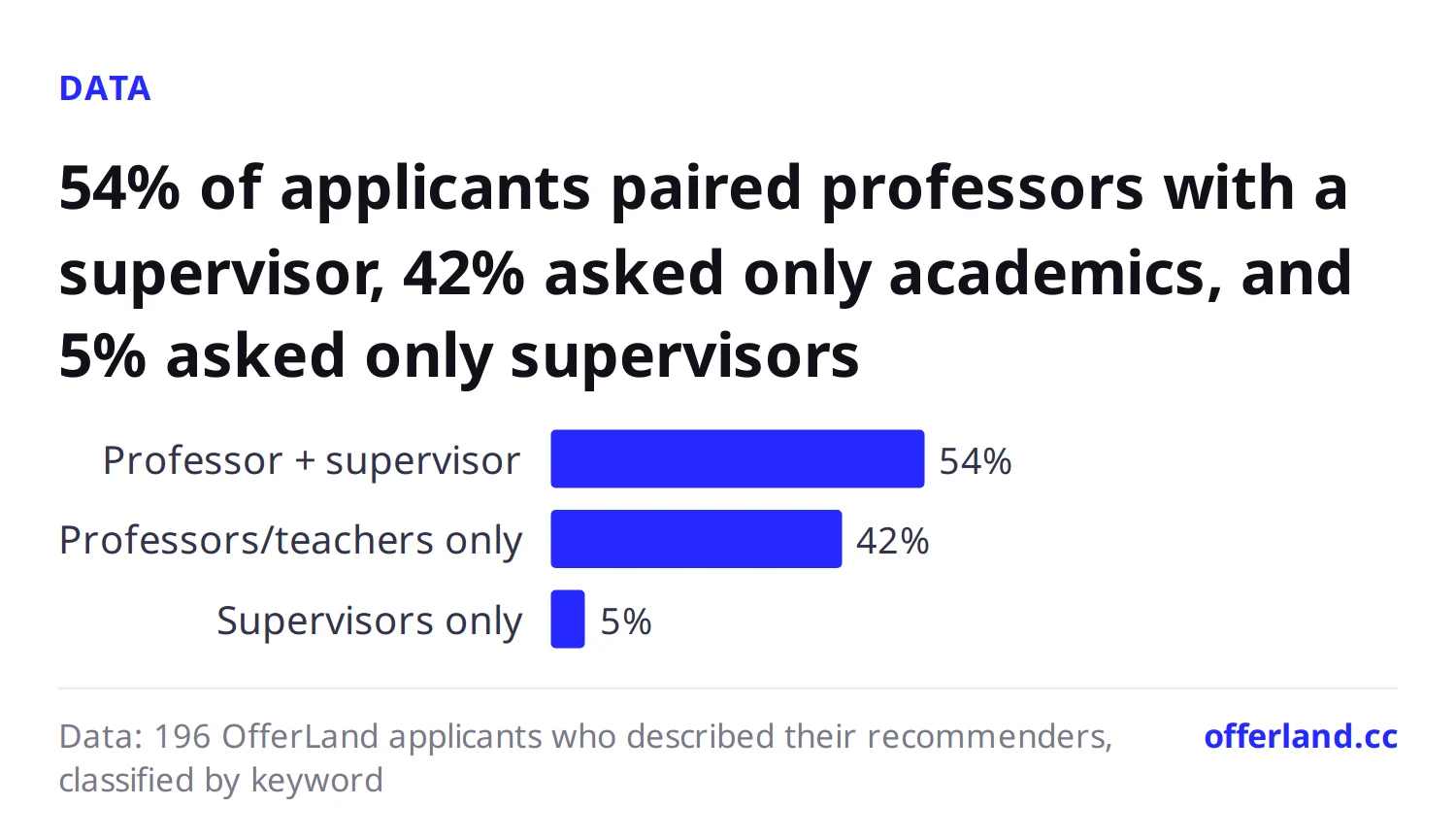
Recommender lineup | People | Share |
|---|---|---|
Professors and supervisors mixed | 105 | 54% |
Professors or teachers only | 82 | 42% |
Supervisors only | 9 | 5% |
Total | 196 | 100% |
This table only shows how people combined recommenders; it doesn't mean any combination makes admission more likely. The question to ask when choosing is who can write about specific things you did.
What professors are good for: academic ability, research potential, classroom performance and how you worked through a project. Research master's and PhD programs usually want at least two academic letters. The strongest usually comes from your project or thesis advisor, who saw you go from framing a question to producing results; next is a professor whose class you did well in and engaged with often. If you only took one large lecture with a professor who can't put a name to your face, the letter will be hard to make specific.
What supervisors are good for: problem-solving, cross-team collaboration, delivering results and professional maturity. MBA and many business programs welcome professional recommenders, and some MBAs prefer a direct supervisor. For applicants with two or three years or more of work experience, swapping one professor for a supervisor is common.
How many: most programs want 2 to 3 letters; go by the number on the school's website. Some systems let you submit one extra optional letter. Unless that person can add something the others don't cover, there's no need to force it.
Who not to ask: relatives, family friends and well-known people you haven't worked with directly.
How to ask: the request email and the info packet
First ask in person or in a short email whether they'd be willing to write you a letter, and send the full materials only after they agree. If your first email dumps a pile of attachments on them, they'll feel like just one step in a process.
The request email should say clearly who you are (which class, which project, which year), what you're applying for, why you're asking them, and your earliest deadline, and end with something like "I completely understand if the timing doesn't work for you."
Once they agree, send an organized info packet. Here's what to include.
Material | Purpose |
|---|---|
List of schools (program names, deadlines, how to submit) | Lets the recommender know how many letters to write and by when |
Résumé (CV) | Fills in experience they don't know about |
Draft SOP or study plan | Keeps the letter in line with your story |
Transcript | Lets professors cite your rank or grades |
A bullet list of "things we did together" | 3 to 5 specific examples, with dates and numbers for the results |
Special requirements by school | For example, letterhead required, or must be sent from a school email address |
The bullet list is the part people skip most. Professors write a lot of letters every year; only if you remind them that "in junior year, my market analysis report cut the forecast error from X to Y" can they write the details. Don't write the whole letter yourself and ask your recommender to sign it; many schools' application terms require the letter to be written by the recommender.
Timeline: start 8 weeks before the deadline
Letters are the part of the application you control least, so start them first. Work backward from your first deadline:
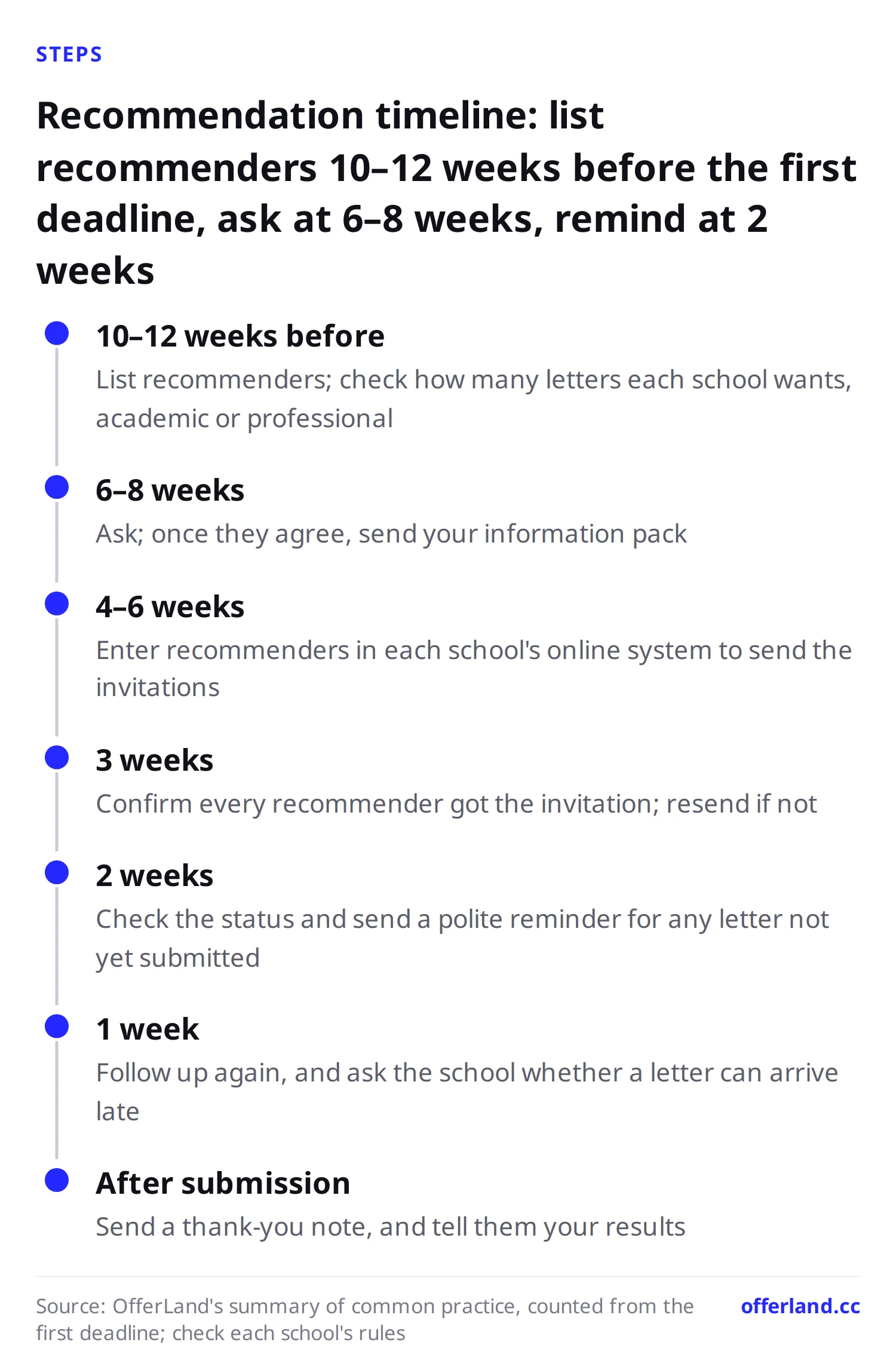
Before the deadline | What to do |
|---|---|
10 to 12 weeks | List your recommenders; confirm how many letters each school needs and whether they accept academic or professional letters |
6 to 8 weeks | Ask; send the info packet once they agree |
4 to 6 weeks | Enter recommender details in each school's online system to trigger the invitation emails |
3 weeks | Confirm every recommender received the system invitation; resend if not |
2 weeks | Check the system status and send one polite reminder for any letters not yet submitted |
1 week | If still not submitted, reach out again and ask whether they need help; at the same time, ask the school whether a late letter is OK |
After submission | Send a thank-you note, and tell your recommenders the results once decisions are out |
If you have many schools with scattered deadlines, enter all of them in the systems in the same week so your recommenders can handle them in one go.
How online recommendation systems work
Most graduate programs in English-speaking countries collect letters through an online system, and the process is broadly the same:
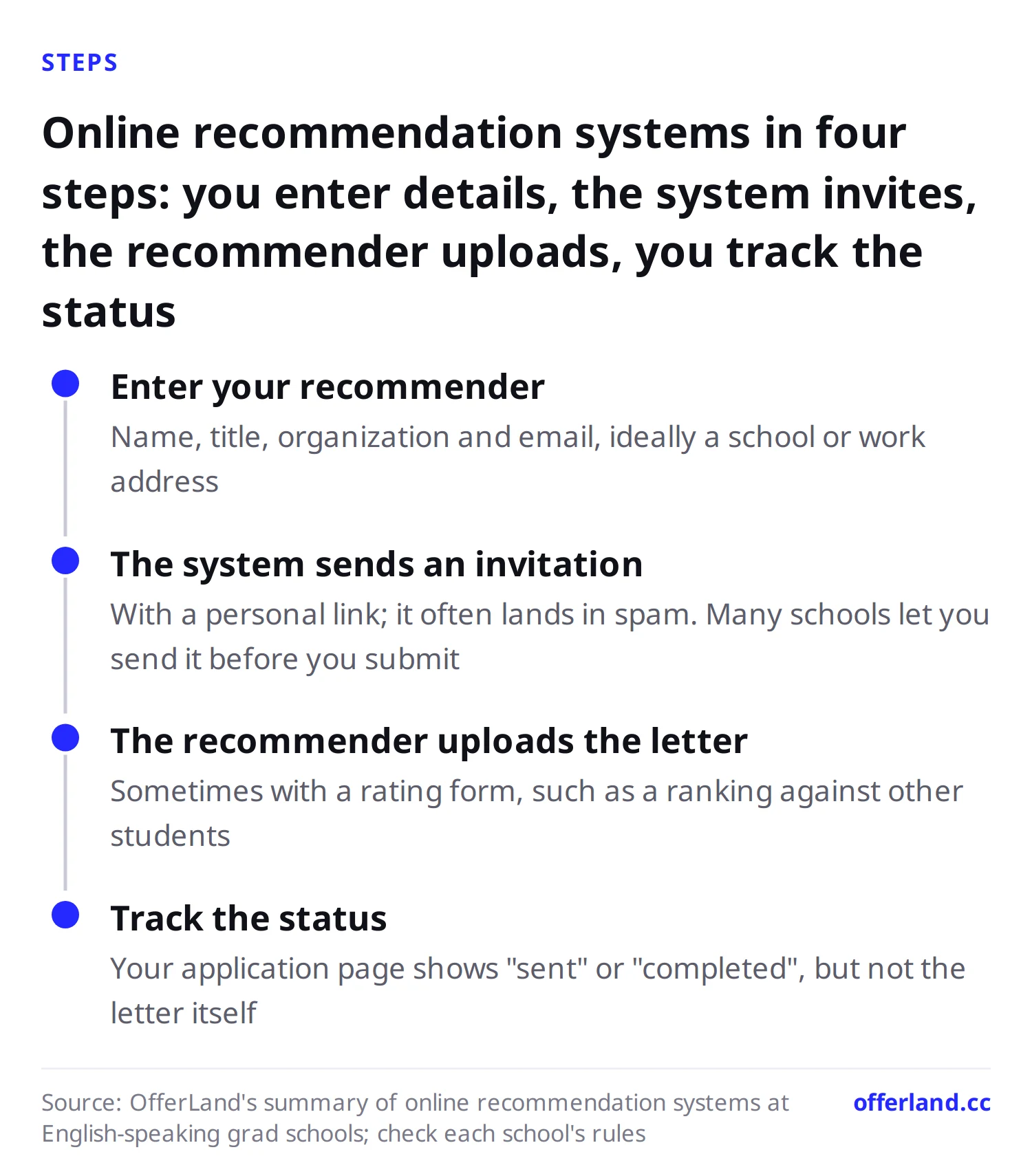
You enter your recommender's name, title, organization and email in the application system, preferably a school or company address.
The system sends an invitation email with a unique link. Many schools let you send invitations before you submit your application.
The recommender uploads the letter through the link, and sometimes also fills in a rating form, such as how you rank compared with other students.
Your application page shows statuses like "Sent" and "Completed," but you can't see the letter itself.
Invitation emails often get flagged as spam, so after entering their details, ask your recommenders to check their spam folder. The same recommender gets a different link from each school, so confirm school by school. Some UK schools email recommenders only after you submit your application; for those programs, submit early.
What the FERPA waiver is: the US FERPA (Family Educational Rights and Privacy Act) lets students view their own education records after they enroll, and recommendation letters are included. The application system will ask whether you waive your right to see your letters, and the usual advice is to waive it. This choice is usually made when you enter your recommenders, and in most cases it can't be changed after the invitation goes out.
What to do when a recommender is late
Late letters are common. Handle them in this order:
Two weeks before the deadline, check the system status; if a letter isn't done, send a short reminder with the link and the deadline.
One week before the deadline, reach out again and ask whether they got the link. The invitation has often ended up in the spam folder.
Email the admissions office. Some programs accept letters a few days late as long as you submitted your own application on time, but policies vary by school, so ask first.
If the letter truly isn't coming, see whether the system lets you change recommenders. That's why it's best to keep a backup on your list.
Common mistakes
Picking a department chair who barely knows you instead of the professor who supervised your project.
Asking only a week or two before the deadline, so the recommender can only dash off a vague letter.
Not giving an info packet, or giving a thick stack they have no time to read.
Entering a different email address at each school, so the recommender's links are scattered across several inboxes.
Not sending a thank-you note after the letters go in, and not telling them how things turned out.
How to use this advice
Applying straight out of college: ask professors for two or more letters, in order of priority: your project or thesis advisor, then professors whose classes you did well in and engaged with. If you've had an internship, your internship supervisor can write the third.
Applying after a few years of work: one professor who can speak to your academic ability, plus your direct supervisor. For research programs, still lean on professors.
Not close to any professors: if you're still in school, start going to office hours now, or join a project or work as a research assistant.
Letters are only one part of the application. To see which schools admitted people with a similar background, filter and compare in the OfferLand admission results search.
Further reading: recommendation letter posts from forum members
8 tips for writing English recommendation letters: covers what a letter should include, such as the relationship between recommender and applicant, specific performance and quantified results.
A strong English recommendation letter template: a complete sample academic recommendation letter in English, with a paragraph-by-paragraph explanation of what each part does.
The complete guide to professor recommendation letters: bilingual Chinese-English templates, structure and how to handle tricky situations: the author's own experience applying to UK grad schools, with sample request emails in Chinese and English for professors you know well and ones you don't.
FAQ
Q: Do my recommendation letters have to come from professors?Research master's and PhD programs usually require at least two academic letters. Applicants to business programs or MBAs, or those with work experience, can often replace some with supervisors. Of the 196 applicants on the site who described their recommenders, 9 (5%) used only supervisors.
Q: Can I ask a professor who doesn't know me well?Yes, but your request email should spell out which class you took, your grade and what reports you did, and your info packet should include specific examples. If there's someone who knows you better, ask them first.
Q: How far in advance should I ask a professor?Ask 6 to 8 weeks before your first deadline, and no later than 4 weeks.
Q: Should I waive my FERPA rights?The usual advice is to waive them. Recommenders can write more candidly, and admissions committees trust the letter more.
Data methodology
Sample: the recommender field in OfferLand users' background profiles (`user_background`), filled in by 206 users. After removing ads, "none" and unreadable entries, 196 applicants whose recommender types could be identified remain.
Classification: by keywords in the text. "Professors" covers academics such as professors, teachers, mentors, department chairs and advisors; "supervisors" covers industry people such as internship supervisors, work supervisors, managers and coworkers. Anyone with both counts as "mixed." Because this is keyword-based, a few descriptions may be misclassified.
This is a free-text field and can't be used to infer which combination has a higher admit rate.
The timeline and process are a summary of general application experience; check each school's website for specifics.
Statistics from OfferLand's own sample, self-reported by users, not official school data. Data as of 2026-10-13.
OfferLand editorial team · Jason · Last updated 2026-11-20 · About the editorial team
See which schools admitted applicants with a background like yours
Search results