Translated by OfferLand from the original Traditional Chinese post. View original

OfferLand
Nov 21
European Master's Admissions Data: Admit Rates in the Netherlands, France and Germany
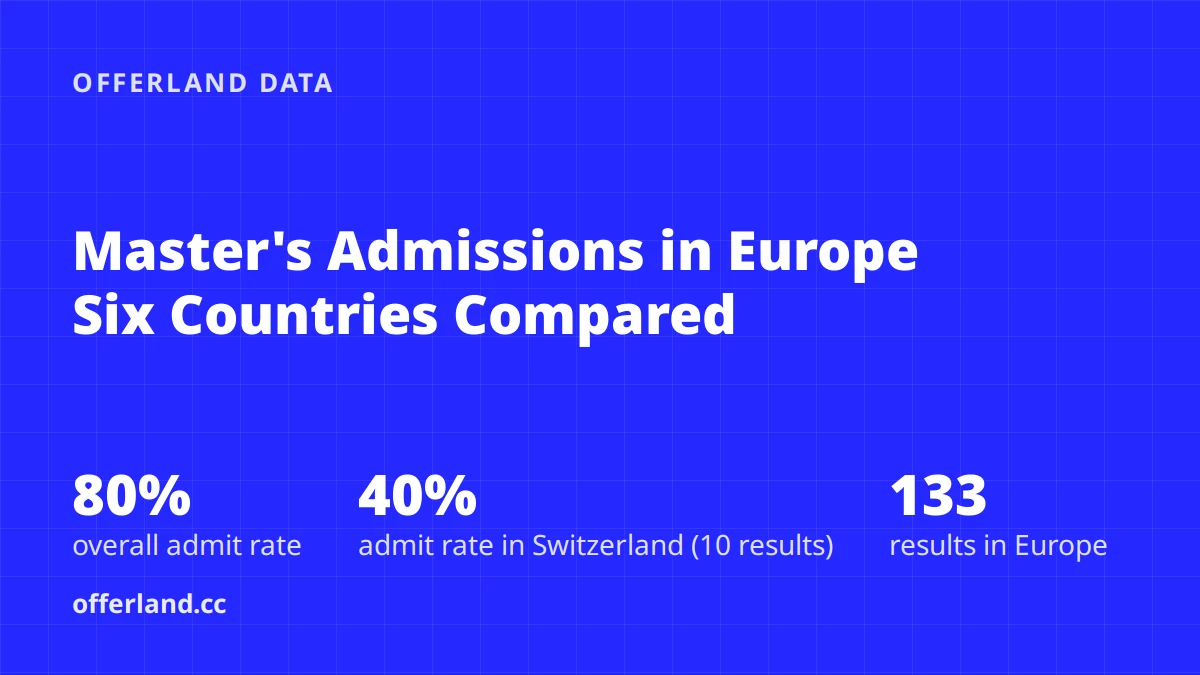
Taiwanese students have reported 133 European application results on OfferLand, with an overall admit rate of 80%, about the same as UK master's programs as a whole. The hard ones are a handful of schools: the two Swiss institutes of technology admitted only 4 of 10, and HEC Paris's Master in Management admitted only 1 of 7. The Netherlands and France draw the most applicants, and business is the most common field, followed by engineering, materials and data science.
The sample is small, so country- and school-level numbers are only a rough guide. The UK has its own column and isn't included here.
Key takeaways
133 European application results: 106 admits and 27 rejections, an 80% admit rate. Master's programs alone account for 118 results, also at 80%.
The Netherlands has the most results at 37 (84% admitted), followed by France at 30 (77%) and Germany at 19 (89%).
Switzerland admitted only 4 of 10 (40%), the only country in the sample with an admit rate below half.
Master in Management programs at French and Spanish business schools account for 26 results; leaving out HEC Paris, only 1 of the remaining 19 was rejected.
Admitted applicants' median IELTS is 7.0 (40 people); median GPA on a 4.0 scale is 3.78 (18 people).
Admit rates by country: the Netherlands and France draw the most applicants
Each of the six main countries has at least 10 results. Finland, Spain, Belgium, Denmark and Portugal each have fewer than 10, so they are combined as "Other Europe."
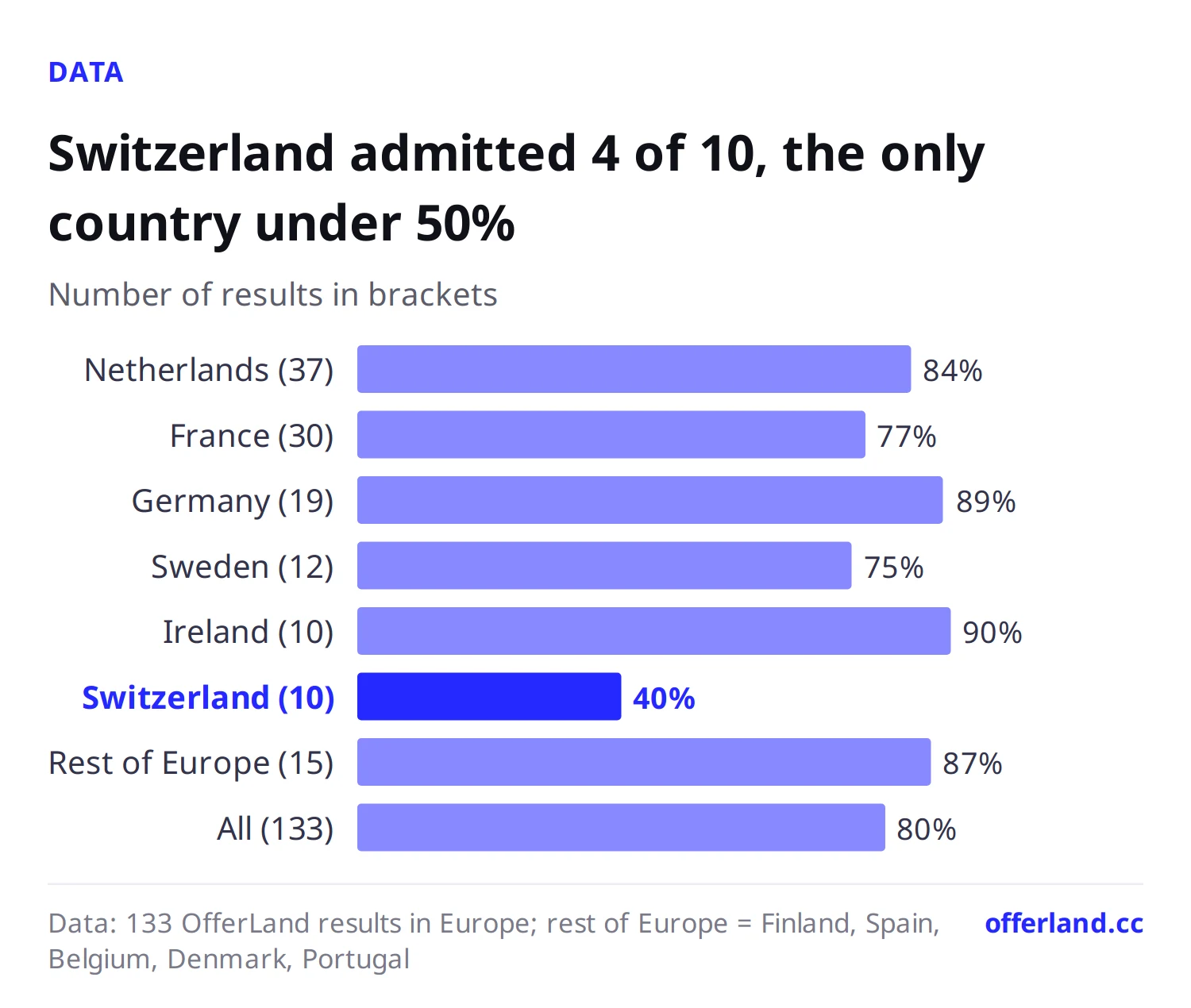
Country | Results | Applicants | Admitted | Rejected | Admit rate |
|---|---|---|---|---|---|
Netherlands | 37 | 25 | 31 | 6 | 84% |
France | 30 | 12 | 23 | 7 | 77% |
Germany | 19 | 10 | 17 | 2 | 89% |
Sweden | 12 | 11 | 9 | 3 | 75% |
Ireland | 10 | 7 | 9 | 1 | 90% |
Switzerland | 10 | 9 | 4 | 6 | 40% |
Other Europe (Finland, Spain, Belgium, Denmark, Portugal) | 15 | 10 | 13 | 2 | 87% |
All | 133 | 66 | 106 | 27 | 80% |
A few things stand out in the table:
France's 30 results come from just 12 people, an average of 2.5 applications each, almost all to business schools. In the Netherlands and Sweden, most people applied to one or two schools.
Germany's 19 results are spread across 14 schools, none with more than 3. Few Taiwanese students apply to German public universities in large numbers, so the sample is thin and scattered.
Of Switzerland's 10 results, 5 were master's applications with 1 admit and 5 were PhD applications with 3 admits. The numbers are tiny, but they match the common impression: EPFL and ETH master's programs are hard to get into.
European schools with the most applications
The table below lists schools with at least 5 results, sorted by number of results. Only 11 schools meet that bar; every other school has 1 to 4 results.
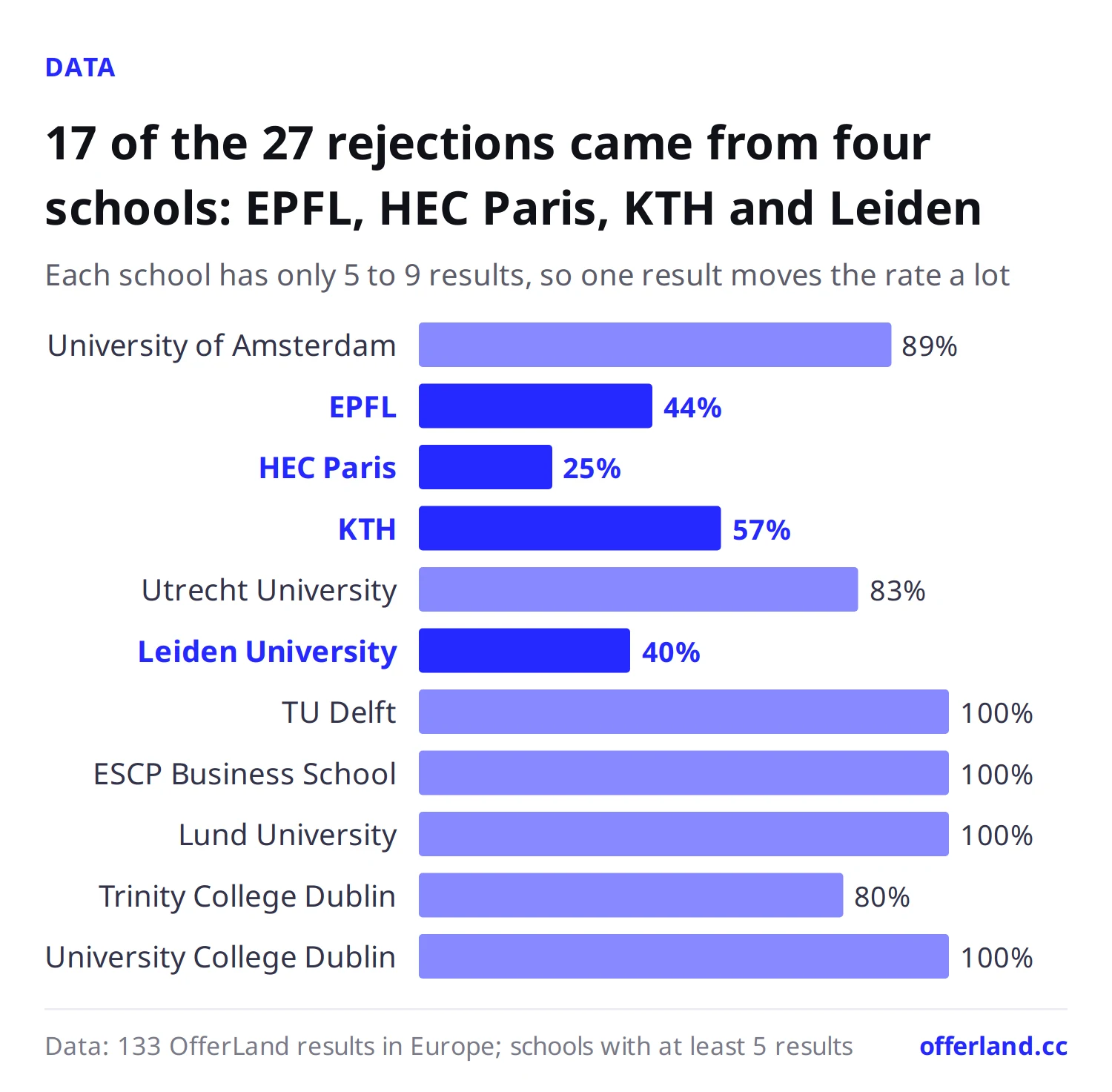
School | Country | QS 2027 | Results | Admitted | Rejected | Admit rate |
|---|---|---|---|---|---|---|
Netherlands | 60 | 9 | 8 | 1 | 89% | |
Switzerland | 22 | 9 | 4 | 5 | 44% | |
France | Not QS-ranked | 8 | 2 | 6 | 25% | |
Sweden | 82 | 7 | 4 | 3 | 57% | |
Utrecht University | Netherlands | 113 | 6 | 5 | 1 | 83% |
Leiden University | Netherlands | 119 | 5 | 2 | 3 | 40% |
Netherlands | 48 | 5 | 5 | 0 | 100% | |
ESCP Business School | France | Not QS-ranked | 5 | 5 | 0 | 100% |
Sweden | 71 | 5 | 5 | 0 | 100% | |
Trinity College Dublin | Ireland | 75 | 5 | 4 | 1 | 80% |
University College Dublin | Ireland | 100 | 5 | 5 | 0 | 100% |
Each school has only 5 to 9 results, so one result either way moves the admit rate a lot. The more reliable signal is where the rejections cluster: of the 27 rejections, 17 came from just four schools, EPFL, HEC Paris, KTH and Leiden.
TU Delft's master's in materials science had 4 results, all admitted; KTH's MSc Computer Science admitted 2 of 3. The business analytics master's programs at the two Irish schools (TCD, UCD) had 3 results each, all admitted as well.
Business vs. STEM: Master in Management leads
Using OfferLand's main field categories, business-related fields (business administration, business analytics, finance, marketing and others) make up nearly half of the results, with a higher admit rate than STEM.
Field group | Results | Admitted | Rejected | Admit rate |
|---|---|---|---|---|
Business (business administration, business analytics, finance, marketing, international business, etc.) | 61 | 52 | 9 | 85% |
STEM and computing (general engineering, electrical engineering and computer science, materials, data science, robotics, etc.) | 44 | 32 | 12 | 73% |
Other fields (social sciences, humanities, design, environment, etc.) | 28 | 22 | 6 | 79% |
Most STEM rejections came from electrical engineering and computer science: 4 of 10 admitted, and 8 of those 10 applications went to three top technical schools, EPFL, ETH Zurich and KTH. Materials science admitted all 9, and data science admitted 8 of 9.
Within business, the biggest cluster is Master in Management (MiM) programs at French and Spanish business schools: 26 results from 9 applicants, nearly 3 applications each on average.
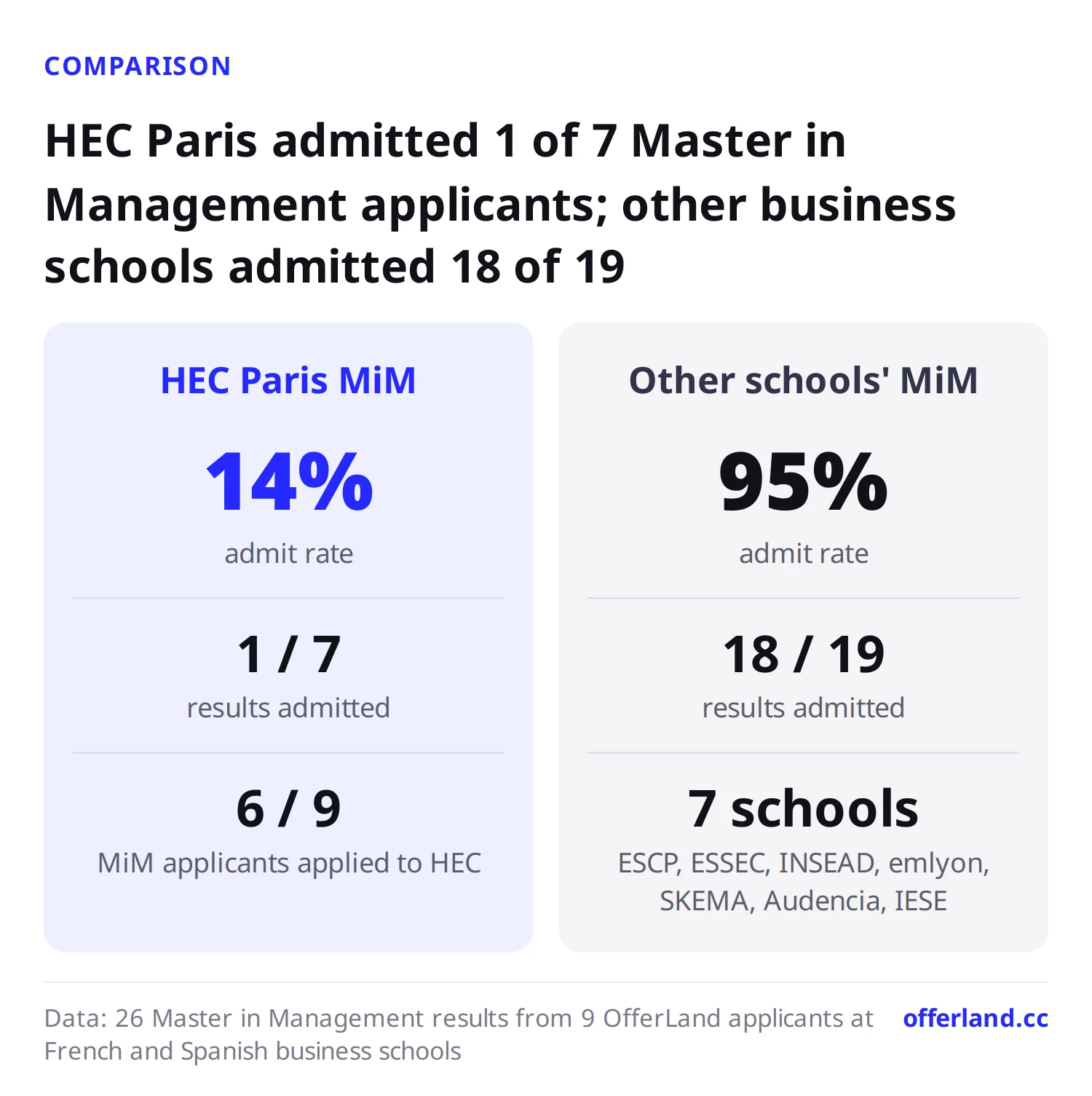
MiM group | Results | Admitted | Rejected | Admit rate |
|---|---|---|---|---|
7 | 1 | 6 | 14% | |
MiM at other schools (ESCP, ESSEC, INSEAD, emlyon, SKEMA, Audencia, IESE) | 19 | 18 | 1 | 95% |
Total | 26 | 19 | 7 | 73% |
The gap between HEC and the other business schools is wider than the gap between any two countries in the sample. Of the 9 MiM applicants, 6 applied to HEC, mostly as a reach school, paired with ESCP, ESSEC or emlyon as their main targets.
On scholarships, 29 of the 106 admits (27%) reported a partial or full scholarship. France had the highest share, with 11 of 23 admits receiving a partial scholarship, mostly from business schools. Scholarships are covered in full in a separate column.
Language scores and GPA
Most English-taught master's programs in Europe accept either IELTS or TOEFL, and the Taiwanese applicants in this sample clearly preferred IELTS: of 66 applicants, 41 reported an IELTS score and 16 reported a TOEFL score.
Measure | People | 25th percentile | Median | 75th percentile |
|---|---|---|---|---|
Admitted applicants' IELTS overall | 40 | 6.88 | 7.0 | 7.5 |
Admitted applicants' TOEFL total | 11 | 102.5 | 104 | 107.5 |
Admitted applicants' GPA (4.0 scale) | 18 | 3.50 | 3.78 | 3.90 |
Only 18 admitted applicants reported a GPA on a 4.0 scale, so the sample is small; the median is the number to look at. IELTS 7.0 is close to the common minimum at most schools, but actual requirements vary by program, so check each school's announcements.
Tuition and fee rules vary widely by country
When choosing a European country, look at tuition differences too. Below are several official rules we verified (on 2026-10-17). Amounts may change every year, so go by each school's latest announcements.
Country | Tuition rules for non-EU students | Source |
|---|---|---|
Germany | Most master's programs at public universities charge no tuition; Baden-Württemberg charges non-EU students €1,500 per semester; some universities in Bavaria also charge tuition; there is also a semester fee of €70 to €430 per semester | DAAD; Baden-Württemberg Ministry of Science |
Switzerland | Starting with the fall 2025 semester, ETH Zurich charges international students CHF 2,190 per semester (CHF 730 for domestic students) | ETH Zurich |
Sweden | Non-EU applicants pay an application fee of SEK 900 per semester; tuition is set by each school | Lund University |
France | Public universities charge non-EU master's students "differentiated tuition," €3,941 per year for 2025-26; business school tuition is separate and set by each school | Université Polytechnique Hauts-de-France |
Netherlands | Non-EU students pay an institutional fee set by each school; for example, University of Twente master's programs for 2026-27 cost €18,200 or €21,700 per year (depending on the program) | University of Twente |
Tuition in Ireland, Finland and other countries is also set by each school, and we didn't verify those one by one. To compare overall budgets across countries, see this article on our site: best-value countries for studying abroad.
How to use this data
The difficulty is concentrated in a few schools. In this sample, most rejections came from EPFL, ETH, HEC Paris, KTH and Leiden. If you're applying to any of them, pair them with at least two or three schools with steady admit rates, such as the University of Amsterdam, TU Delft, Lund or UCD.
MiM programs can be applied to as a set. French business school MiM programs have high admit rates, and applicants averaged nearly 3 applications each. HEC as the reach with ESCP, ESSEC and emlyon as the main targets is a common mix in the sample.
In STEM, look at tuition before rankings. Most German public universities charge no tuition for master's programs, ETH Zurich's tuition is relatively low but admission is very hard, and the Netherlands and Sweden charge high tuition. The total cost of the same master's degree can differ a lot.
Aim for IELTS 7.0. The median for admitted applicants is exactly 7.0, and the 75th percentile is 7.5. You can still apply with only TOEFL, but confirm school by school whether it's accepted and what the section minimums are.
To look up past results for a specific school or program, use the admission results search and filter by country and program.
FAQ
Q: Is it easy to get into a master's program in Europe? What's the admit rate?Across OfferLand's 133 European application results, the overall admit rate is 80%. The differences are concentrated by school, though: EPFL, HEC Paris MiM and Leiden all have admit rates below 50%, while most schools are above 80%.
Q: Which European country do the most Taiwanese students apply to for a master's?In this sample, the Netherlands (37 results, 25 people) and France (30 results, 12 people). In the Netherlands it's mainly comprehensive universities; in France it's almost all business schools.
Q: Is a master's degree in Germany really tuition-free?According to DAAD, most master's programs at German public universities charge no tuition, but Baden-Württemberg charges non-EU students €1,500 per semester, some universities in Bavaria also charge tuition, and every school has a semester fee. Check the school's tuition page before applying.
Q: Should I take IELTS or TOEFL for a European master's?Most English-taught master's programs accept both. In the sample, 41 people reported IELTS and 16 reported TOEFL; admitted applicants' median IELTS was 7.0 and median TOEFL was 104.
Data methodology
Sample: application results reported by OfferLand users for schools in the Netherlands, France, Germany, Sweden, Switzerland, Ireland, Finland, Spain, Belgium, Denmark and Portugal, covering master's (118 results), PhD (11 results) and MBA (4 results) programs, excluding bachelor's. 133 results in total, from 66 applicants at 47 schools.
Timing: by result date, 45 results in 2023, 51 in 2024, 17 in 2025, 13 in 2026 and 7 in 2022 or earlier. Data as of 2026-10-17.
Admit rate = (admitted + admitted and enrolled) ÷ (admitted + admitted and enrolled + rejected). This sample has no waitlisted or pending results.
Every cell has at least 5 results. Countries with fewer than 5 are combined into "Other Europe," and schools with fewer than 5 have no admit rate listed.
Fields follow OfferLand's main field categories. GPA uses only 4.0-scale scores between 0 and 4. Language scores use each person's highest overall score and count applicants with at least one admit.
Rankings are QS 2027. Most business schools have no QS university ranking and are marked "Not QS-ranked."
These are statistics from OfferLand's own sample, self-reported by users, not official school data. People with good results may be more likely to report, so admit rates may be higher than the reality.
External sources (verified 2026-10-17): DAAD, "Costs of education and living"; Baden-Württemberg Ministry of Science, Research and the Arts, "Tuition fees for international students"; ETH Zurich, "Tuition fees"; Lund University, "Application fee"; Université Polytechnique Hauts-de-France, "Droits d'inscription" (2025-26); University of Twente, "Tuition fees" (2026-27).
Further reading
OfferLand editorial team · Jason · Last updated 2026-11-21 · About the editorial team
See which schools admitted applicants with a background like yours
Search resultsSchools in this post
- HEC Paris
- École Polytechnique Fédérale de Lausanne (EPFL)
- KTH Royal Institute of Technology
- Eidgenössische Technische Hochschule Zürich (ETH Zurich)
- ESCP Business School
- ESSEC Business School
See each school's applicant numbers, admit rates and past applicants' results
See admission data for these schools