Translated by OfferLand from the original Traditional Chinese post. View original

OfferLand
Nov 10
Grad School in Korea: SKY and KAIST Deadlines, Language Requirements and GKS
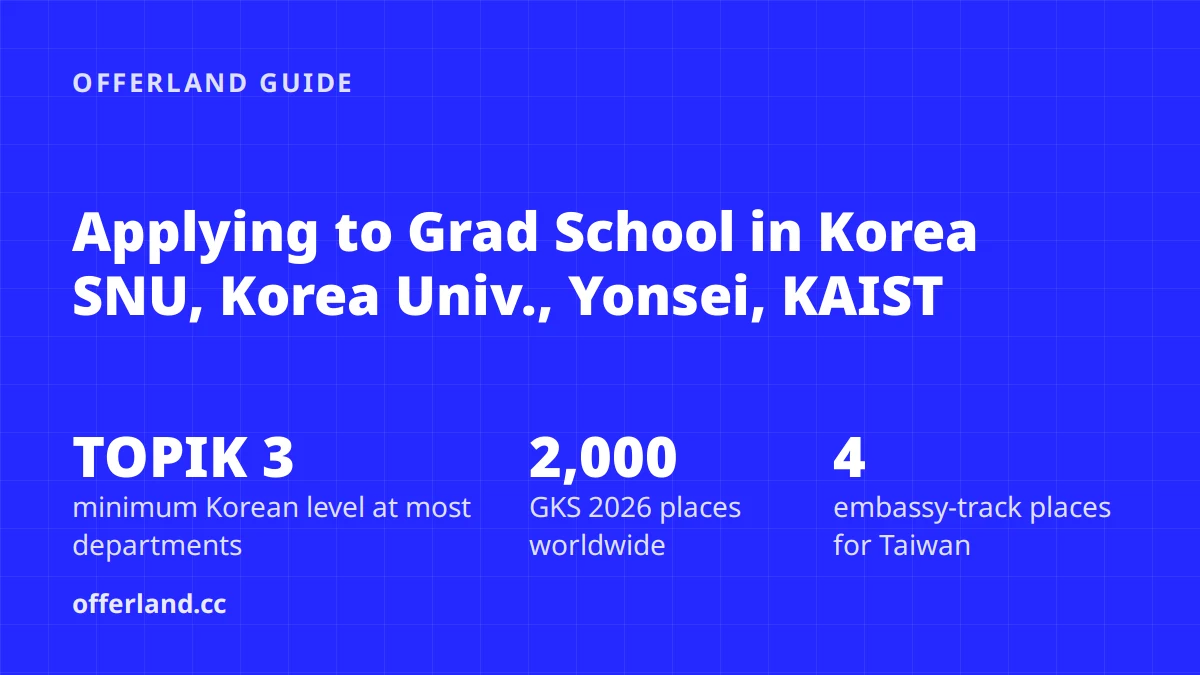
International students applying to graduate school in Korea usually need to submit their applications six months to a year before starting. For the spring 2027 intake (starting March 2027), for example, Seoul National University's online application closed in July 2026, KAIST's in early September, Korea University's in the first part of September, and Yonsei University's in mid-October. On language, most departments at Seoul National, Korea and Yonsei accept either TOPIK level 3 or an English test score, while KAIST mainly uses English for international students. If you want a Korean government scholarship, you'll also need to prepare a separate GKS application, which opens every February.
Key takeaways
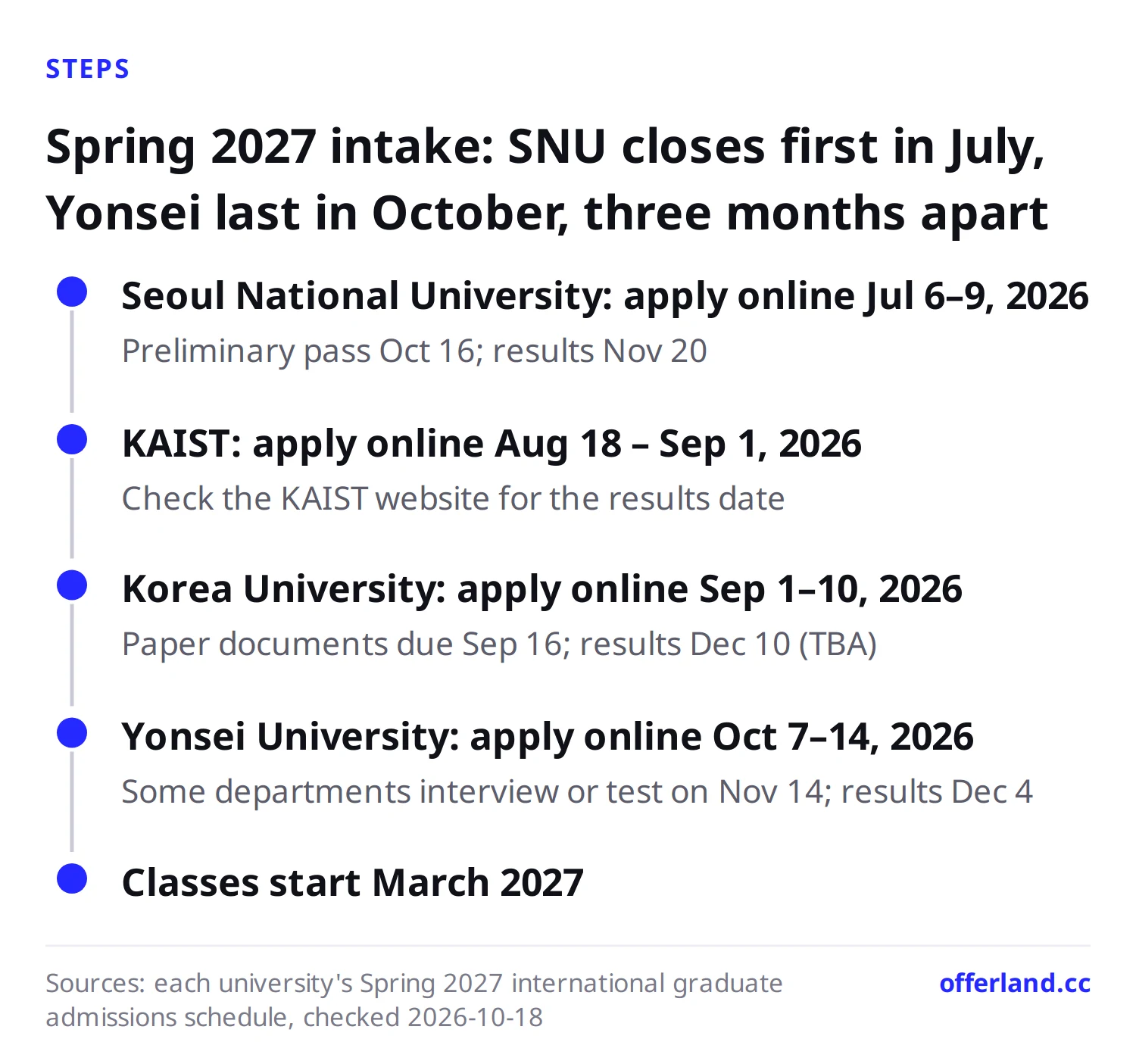
Timeline: online applications for spring 2027 ran July 6–9, 2026 at Seoul National University, August 18–September 1 at KAIST, September 1–10 at Korea University, and October 7–14 at Yonsei University. Each school also has a fall intake.
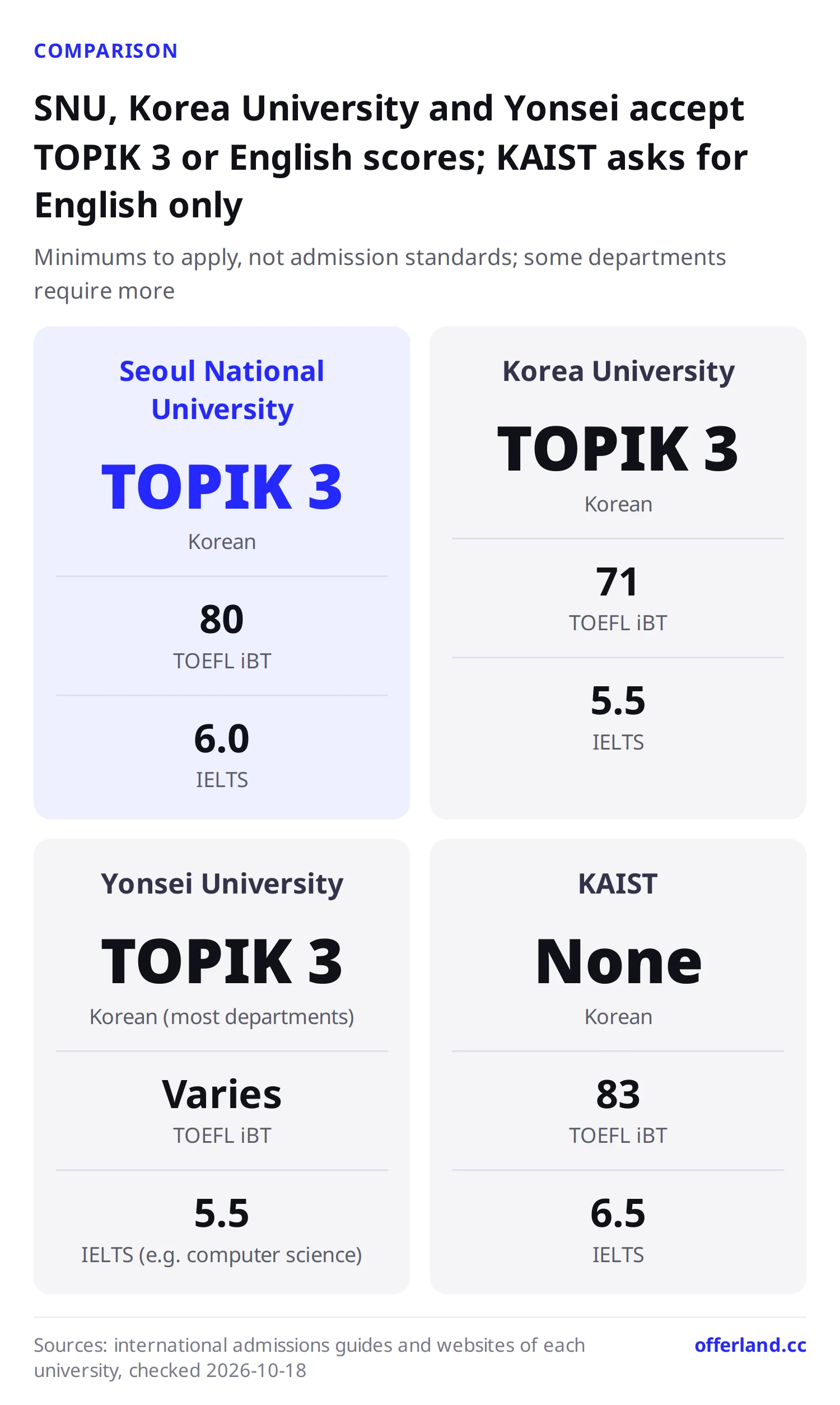
Language: Seoul National University's minimum is TOPIK level 3, or TOEFL iBT 80 or IELTS 6.0; KAIST requires TOEFL iBT 83 or IELTS 6.5. Some departments accept only TOPIK, and at level 5 to 6.
Tuition: at Seoul National University, the first semester of the 2026 academic year (including the entrance fee) is KRW 3,278,000 for humanities and social sciences and KRW 3,997,000 for engineering; at Yonsei University, electrical engineering is KRW 8,739,000 for fall 2026.
GKS: 2,000 places worldwide in 2026. The master's track is 1 year of Korean language study plus 2 years of degree study, with a living allowance of KRW 16,560,000 per year during the degree; the embassy track has 4 places for Taiwan.
GPA cutoff: GKS requires an average of at least 80 out of 100 in your previous degree, a GPA of 2.64 or higher on a 4.0 scale, or a class rank in the top 20%.
Application timelines at the four schools
The table below shows the spring intake (starting March 2027) schedules published on each school's official website. All of these dates have passed, but you can use them to estimate the next round: Seoul National University is earliest and Yonsei University latest, three months apart.
School | Online application | Results announced | Application fee | Notes |
|---|---|---|---|---|
Seoul National University (SNU) | Jul 6–9, 2026 | Nov 20, 2026 | KRW 90,000 | Provisional admits announced Oct 16, then original documents mailed |
KAIST | Aug 18–Sep 1, 2026 | Check the official website | Check the official website | Fall 2027 intake planned for Jan 7–Feb 5, 2027 (listed as TBA on the website) |
Korea University (Graduate School) | Sep 1–10, 2026 | Dec 10, 2026 (TBA) | KRW 127,000 (incl. processing fee) | Paper documents must arrive by Sep 16 |
Yonsei University (Graduate School) | Oct 7–14, 2026 | Dec 4, 2026 | KRW 130,000 | Some departments hold interviews or practical assessments on Nov 14 |
Korea's academic year starts in March, and all four schools' websites state that international students can enter in spring or fall. Spring intake applications fall in the summer and fall of the previous year; fall intake applications are mostly early in the same year. Online application windows at these four schools last only a few days to two weeks, so it's best to have recommendation letters, transcripts and proof of funds ready before they open. Yonsei University's admission guidelines require proof of funds of at least KRW 22 million.
The table above lists only the general Graduate School at each university. Professional graduate schools such as Yonsei's Graduate School of International Studies (GSIS) and its business school have separate admission guidelines and different schedules.
Do you need Korean? TOPIK and English-taught programs
It depends on the department. The general rule for international students at Seoul National, Korea and Yonsei is "meet the requirement in either Korean or English," but some departments require Korean. The table below summarizes the minimums from each school's admission guidelines or website; these only qualify you to apply and are not admission standards.
School | Korean | English | Departments to watch |
|---|---|---|---|
Seoul National University | TOPIK level 3 (or completion of level 4 at a Korean university's language institute) | TOEFL iBT 80 (4.0 for tests taken after 2026/1/21), IELTS 6.0, TEPS 269 | Business administration and the interdisciplinary program in arts management require TOPIK level 6; design-related majors require level 5. Most business administration courses are taught in Korean |
Korea University | TOPIK level 3 | TOEFL iBT 71 (3.5 on the new scale), IELTS 5.5, New TEPS 326, CEFR B2 | Economics requires both Korean and English scores; the business analytics major requires Korean; creative writing requires TOPIK level 6 |
Yonsei University | Varies by department; mostly TOPIK level 3 | Varies by department, e.g. computer science and engineering: TOEFL 3.5 on the new scale (59 on the old), IELTS 5.5 | Marketing and management majors in business administration require TOPIK level 6 and don't accept English scores; psychology requires TOPIK level 5 |
KAIST | Not required | TOEFL iBT 83 (4.5 on the new scale), IELTS 6.5, TOEIC 720, TEPS 326 | KAIST's official language of communication and instruction for international students is English |
Three things to keep in mind when reading this table:
Score validity: Seoul National University accepts only scores obtained on or after July 9, 2024, and Yonsei University requires tests taken on or after December 4, 2024. Scores from tests taken too early are treated as not submitted.
Meeting the English requirement doesn't mean the courses are in English: Seoul National University's admission guidelines specifically state that most business administration courses are taught in Korean and that only applicants whose Korean is good enough to take courses should apply. By contrast, the Global Public Administration major at SNU's Graduate School of Public Administration is taught, assessed and written up entirely in English.
If you'd rather avoid Korean: start by looking at English-focused schools like KAIST, each university's graduate school of international studies, or programs explicitly taught entirely in English, such as SNU's Global Public Administration major.
The site has a post sharing requirements for studying in Korea (focused on SKY), whose author points out that the level 3 or 4 listed in admission guidelines is only the minimum: Korean schools admit the strongest applicants, so the higher your Korean score, the better. It's worth reading for grad school applications too.
Tuition and the schools' own scholarships
Seoul National University, a national university, is considerably cheaper than the private Korea University and Yonsei University, and at the same school science and engineering cost more than humanities. Below is international student tuition published on each school's official website, in Korean won. Seoul National and Yonsei list fees per semester; Korea University's tuition table doesn't say whether its figures are per semester or per year, so confirm with the school before citing them.
School | Applicable year | Humanities and social sciences | Science and engineering | School scholarships (as worded on the website) |
|---|---|---|---|---|
Seoul National University | First semester of 2026 academic year, incl. entrance fee of 169,000 | 3,278,000 | Engineering 3,997,000 | GSFS: full tuition waiver for up to 2 years plus living expenses (amount varies by college), only for applicants who have never studied at a Korean educational institution |
Korea University | Listed as 2026 academic year, master's, incl. entrance fee of 1,142,000 | 6,416,500 (incl. optional student union fee of 37,500) | Engineering and arts 8,571,500 | Scholarship applications must include an original English test score report (as worded on the website) |
Yonsei University | Fall 2026, incl. entrance fee of 1,028,000 | College of Liberal Arts 6,507,000 | Electrical and electronic engineering 8,739,000 | International students' Companion Scholarship provides a living allowance automatically, for up to 4 semesters for master's and doctoral students |
KAIST | Check the official website | – | – | KAIST Scholarship covers full tuition plus a monthly stipend; KGPS for master's students is KRW 1,000,000 per month for 4 semesters |
KAIST's website says 94% of international students receive the KAIST Scholarship. KGPS, however, goes only to the most competitive applicants recommended by their department head, and stipend amounts vary by college. Applicants who choose the KAIST Scholarship as their source of funding are reviewed automatically and don't need to apply separately.
How to apply for the GKS Korean government scholarship
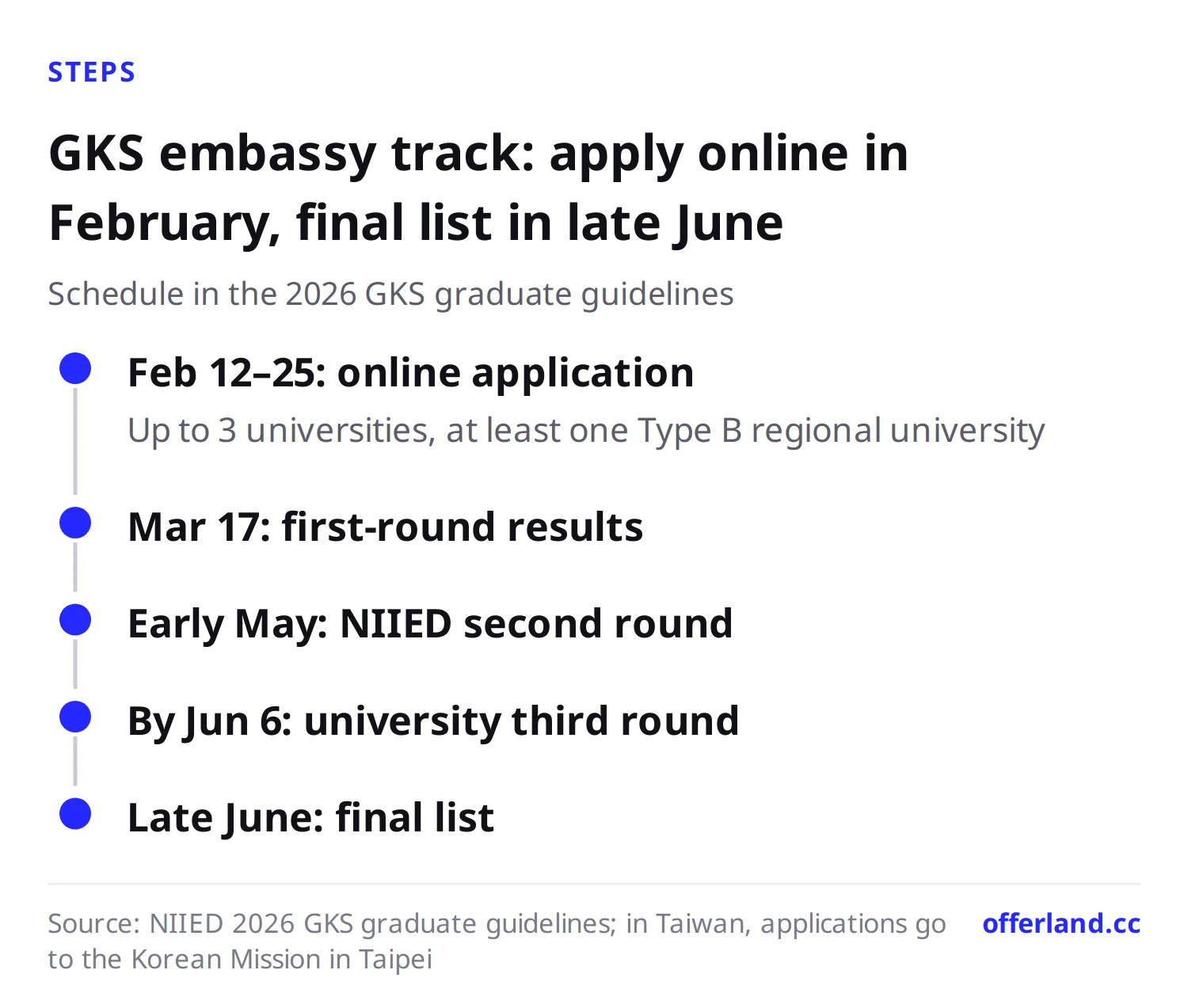
GKS (Global Korea Scholarship) is run by the National Institute for International Education (NIIED) under Korea's Ministry of Education and covers airfare, tuition and living expenses. The details below come from the 2026 GKS graduate program guidelines (published February 2026). According to the annual schedule on the Study in Korea website, the guidelines are published in February, and the 2027 terms may change.
Item | 2026 guidelines |
|---|---|
Places | 2,000 worldwide: 800 through the embassy track, 1,200 through the university track |
Places for Taiwan | 4 general places through the embassy track; 1 R-GKS place through the university track (Type B regional universities only) |
Program length | Master's 3 years (1 year of Korean + 2 years of degree study); PhD 4 years (1 year of Korean + 3 years of degree study) |
Age | Under 40 (born on or after September 1, 1986) |
Grades | 80 or above out of 100, or top 20% of the class, or a GPA of at least 2.64/4.0 or 2.80/4.3 |
Not eligible | Graduates (including expected graduates) of Korean universities, and past recipients of a Korean government degree scholarship |
Benefits | Round-trip economy airfare; tuition up to KRW 5 million (entrance fee paid by the university); Korean language course tuition of KRW 5.2 million; living allowance of 14,400,000 per year during the language course and KRW 16,560,000 per year during the degree |
Embassy track schedule | Online application 2/12–2/25, first-round results 3/17, NIIED second round in early May, university third round by 6/6, final list in late June |
A few details that are easy to miss:
On the embassy track you can choose up to 3 universities, and at least one must be Type B (a regional university outside the Seoul metropolitan area). Seoul National, Korea, Yonsei and KAIST are all Type A. The guidelines warn that applicants who fill all 3 choices with popular schools may pass the second round and still be rejected by all 3 schools in the third.
On the university track you can list only 1 department at 1 university, and each university sets its own application period; you can't apply through both tracks.
You must reach TOPIK level 3 by the end of the Korean language course to start the degree program, and some departments require level 4. Those who already hold TOPIK level 5 or 6 when selected can skip the language course and go straight to the degree.
Bonus points: TOPIK level 3 or above adds 10% to your total score, and applying to a science or engineering department adds 5%. English scores also count; for example, TOEFL iBT 95 or above or IELTS 7.0 or above earns 80% of the language points.
In Taiwan, the embassy track is handled by the Korean Mission in Taipei; check its announcements each year for the number of places and how to submit.
How to use this information
Decide on a Korean-language or English-language route first: if you already have TOPIK level 5 or above, you can consider humanities and business departments at SKY; if you only have English scores, check each department's page to confirm it accepts English scores and teaches in English before deciding where to apply.
Put the timeline on your calendar: spring intake runs from Seoul National University in July to Yonsei University in October, and GKS opens the following February. If you want to try for GKS first and apply on your own funding if you aren't selected, you can submit GKS in February and then apply to schools' spring intakes that summer.
Tier your GKS choices: among your 3 choices, include a Type B school you'd really be willing to attend, rather than filling all 3 with SKY and KAIST.
Apply to the US, UK or elsewhere as a backup: OfferLand currently has only 1 reported result from Korea, too few for an admit rate analysis. If you're also applying to other countries, use the OfferLand admission results search to find people with similar backgrounds, or see the 2026 admissions report and admissions data by field. Yonsei University has a school page on the site, as well as a program page for the Master of International Trade, Finance and Management (ITFM); if you've applied, please report your results.
FAQ
Do I need to speak Korean to go to grad school in Korea?
Not necessarily. Most departments at Seoul National, Korea and Yonsei accept either TOPIK level 3 or an English score, and KAIST mainly uses English for international students. Some departments, such as business administration, accept only TOPIK, and at level 5 to 6, so check the department's requirements before applying.
When do I apply to grad school in Korea?
For the spring intake starting in March, apply in July to October of the previous year: for spring 2027, Seoul National University in July, KAIST in late August to early September, Korea University in September and Yonsei University in October. For the fall intake starting in September, most applications are early in the same year; check each school's admission guidelines for dates.
How many GKS places are there for Taiwan?
The 2026 GKS graduate guidelines give Taiwan 4 places through the embassy track, plus 1 R-GKS place through the university track (Type B regional universities only). The number changes every year; check announcements from NIIED and the Korean Mission in Taipei.
How long is a GKS master's?
Usually 3 years: 1 year of Korean language classes in Korea, then 2 years of master's study. You need TOPIK level 3 by the end of the language course to start the degree program; those who already hold TOPIK level 5 or 6 when selected can skip the language course.
How much is grad school tuition at Seoul National University?
According to SNU's spring 2027 admission guidelines for international students (2026 academic year rates), the first semester, including the entrance fee, is KRW 3,278,000 for humanities and social sciences and KRW 3,997,000 for engineering; the entrance fee is KRW 169,000 of that. Rates may change every year.
About the information
This is a guide and does not use OfferLand's application results data (the site currently has only 1 reported result from a Korean school, not enough for statistics). Dates, requirements and fees in this post come from the schools' official websites and NIIED's official guidelines, verified on 2026-10-18. Each school updates its admission guidelines every semester, and department requirements may change, so rely on the latest official announcements. This post does not represent the position of any school or organization.
NIIED, 2026 Global Korea Scholarship Application Guidelines for Graduate Degrees (English version, February 2026; the Korean version prevails).
Study in Korea (studyinkorea.go.kr), GKS Scholarship pages: allocation of places, age and grade requirements, annual schedule.
Embassy of the Republic of Korea in Finland, 2026 GKS-G application announcement: embassy-track application period and first-round schedule.
Seoul National University, Admissions for Graduate, Spring 2027 (2027 Spring Graduate Admissions Guide for International Students), including the schedule, language requirements, GSFS scholarship and 2026 academic year tuition table.
KAIST International Graduate Admissions: Yearly Timelines, Eligibility Requirements, KAIST Scholarship and Cost of Studying at KAIST pages.
Korea University Graduate School (graduate2.korea.ac.kr): Admission Schedule, Eligibility and Tuition Fee pages.
Yonsei University Graduate School: Spring 2027 international student application schedule page, and the Spring 2027 Graduate School Admission Guideline for International Students (Seoul Campus).
OfferLand editorial team · Jason · Last updated 2026-11-10 · About the editorial team
See which schools admitted applicants with a background like yours
Search resultsSchools in this post
See each school's applicant numbers, admit rates and past applicants' results
See admission data for these schools