Translated by OfferLand from the original Traditional Chinese post. View original

OfferLand
Updated Oct 21
Working in the US After Graduation: OPT, STEM OPT, and the H-1B Lottery
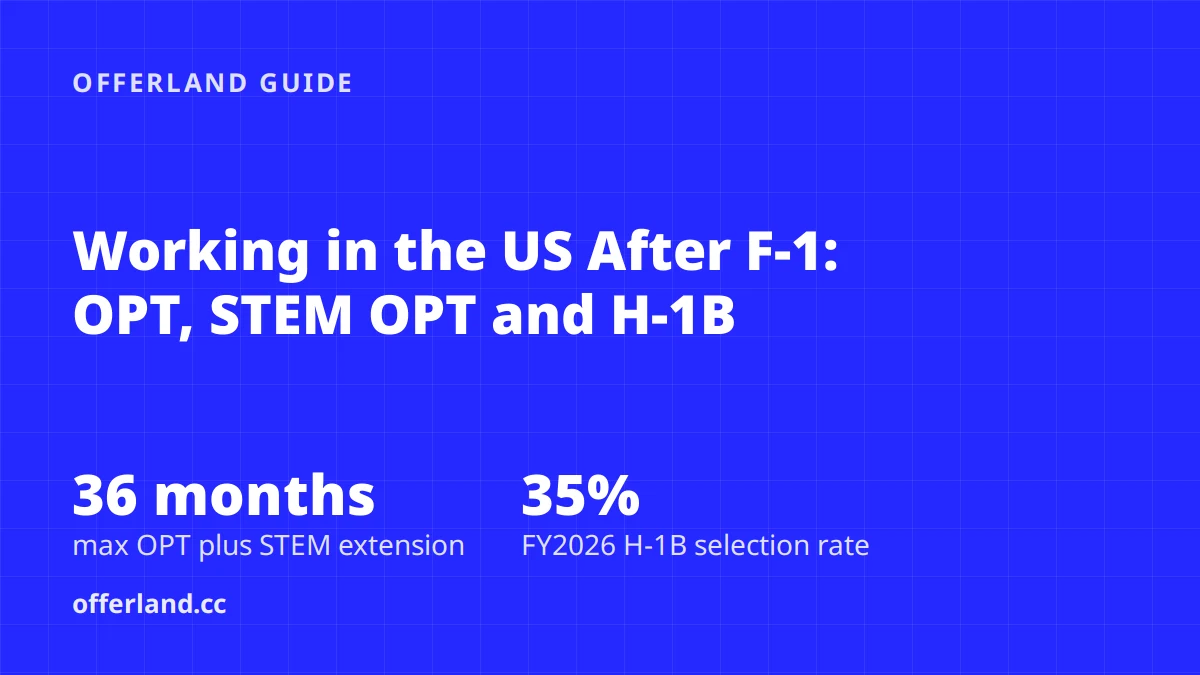
After graduating in the US, F-1 students can first work for 12 months on OPT (once per degree level), and those in STEM fields can then apply for a 24-month STEM OPT extension, for up to 36 months in total. To stay longer, you usually need an employer to register you for the H-1B lottery: there are 65,000 regular slots, plus 20,000 reserved for people with a US master's degree or higher. Starting with FY2027, the lottery is weighted by wage level: the higher the salary, the better the chance of being selected.
The rules and fees below come from the USCIS and DHS websites and were verified on October 18, 2026. Immigration rules changed often in 2026, so check the latest official announcements again before you apply, and ask your school's DSO or an immigration attorney if you have questions. This article is not legal advice.
Key points
OPT: up to 12 months per degree level. File Form I-765 between 90 days before and 60 days after graduation; the filing fee is $470 online ($520 on paper).
STEM OPT: another 24 months. The employer must be enrolled in E-Verify and sign the Form I-983 training plan; the unemployment limit rises from 90 days to 150 days in total.
The H-1B registration fee is $215 per person. From FY2027, registrations are weighted by OEWS wage level: Level IV is entered into the selection pool 4 times, Level I only 1 time.
Based on USCIS figures, the annual H-1B selection rate has ranged from 25% to 46%: lowest in FY2024, at about 25%, and about 35% in FY2026.
Since September 15, 2026, newly admitted F-1 students get a fixed period of stay, and the post-graduation departure grace period has been cut from 60 days to 30 days. Separately, DHS proposed an OPT fee in October; it has not taken effect.
OPT: your first work authorization after graduation
OPT (Optional Practical Training) is work authorization for F-1 students, and the work must be directly related to your major. You get 12 months once each for a bachelor's, master's, and doctoral degree; any pre-completion OPT used before graduation is deducted from your post-graduation allowance.
To apply, your school's DSO first recommends you in SEVIS, and then you file Form I-765 with USCIS. The table below lists the official timing rules.
Item | Rule |
|---|---|
Length | Up to 12 months per degree level |
Filing window | From 90 days before graduation to no later than 60 days after |
After DSO recommendation | File I-765 within 30 days |
Starting work | Only after I-765 is approved and you have your EAD card |
Hours | At least 20 hours per week on post-completion OPT |
Unemployment | Up to 90 days cumulative |
Reporting | Notify your DSO of name, address, or employer changes within 10 days |
Filing fee | $470 online, $520 on paper |
Premium processing | An additional $1,780 |
Two things are often overlooked. Transferring schools or starting a higher degree automatically ends your existing OPT, and continuing to work after your EAD is terminated has serious consequences. OPT only covers work related to your major, so when you job hunt, make sure the role matches.
STEM OPT extension: 24 more months
If your major is on the DHS STEM Designated Degree Program List, you can apply for a 24-month extension as your 12-month OPT nears its end. Whether a program counts as STEM depends on the CIP code on your I-20, not the program name, so you can ask the school to confirm while choosing schools.
STEM OPT has stricter employer requirements than regular OPT. The main conditions are below.
Item | Rule |
|---|---|
Degree | On the STEM list; the school must be accredited and SEVP-certified |
Employer | Must be enrolled in E-Verify and have an EIN |
Training plan | Employer and student complete Form I-983 together |
Hours | At least 20 hours per week per employer |
Pay | Commensurate with similarly situated US workers |
Filing window | Within 90 days before current OPT expires; within 60 days of DSO recommendation |
While pending | If filed on time, work authorization is automatically extended for 180 days |
Unemployment | 60 more days, up to 150 days total including OPT |
Reporting | Confirm your information with your DSO every 6 months; submit a self-evaluation once a year |
A previous STEM degree may also qualify you. For example, if your master's isn't in STEM but your bachelor's in the US was, you can use that degree as long as both schools are accredited, the job is directly related to that degree, and you haven't already used it for an extension. If you later earn a higher-level STEM degree, you can apply for another 24-month extension.
What STEM OPT adds is time. Regular OPT lasts only 12 months, which usually covers just one H-1B lottery; the 24-month extension gives you roughly 2 more lottery chances, depending on your graduation month and OPT start date. To see admission results by field, check OfferLand's admissions data by field.
The H-1B lottery: caps, weighting, and selection rates
The H-1B is a work visa for specialty occupations, and the position usually requires at least a relevant bachelor's degree. Each year there are 65,000 regular slots (up to 6,800 of which are set aside for H-1B1 workers from Chile and Singapore), plus 20,000 "master's cap" slots (the advanced degree exemption), open only to people with a master's degree or higher from a US institution of higher education.
The selection runs in order: regular-cap slots are drawn first from all eligible registrations, and US master's holders who weren't selected get a second draw for the master's cap. So a US master's degree effectively gives you two chances.
Starting with FY2027, USCIS switched to weighted selection. When registering, the employer enters the position's SOC code, the work location, and which Department of Labor OEWS wage level the offered salary falls under. The higher the wage, the more times the registration is entered into the selection pool.
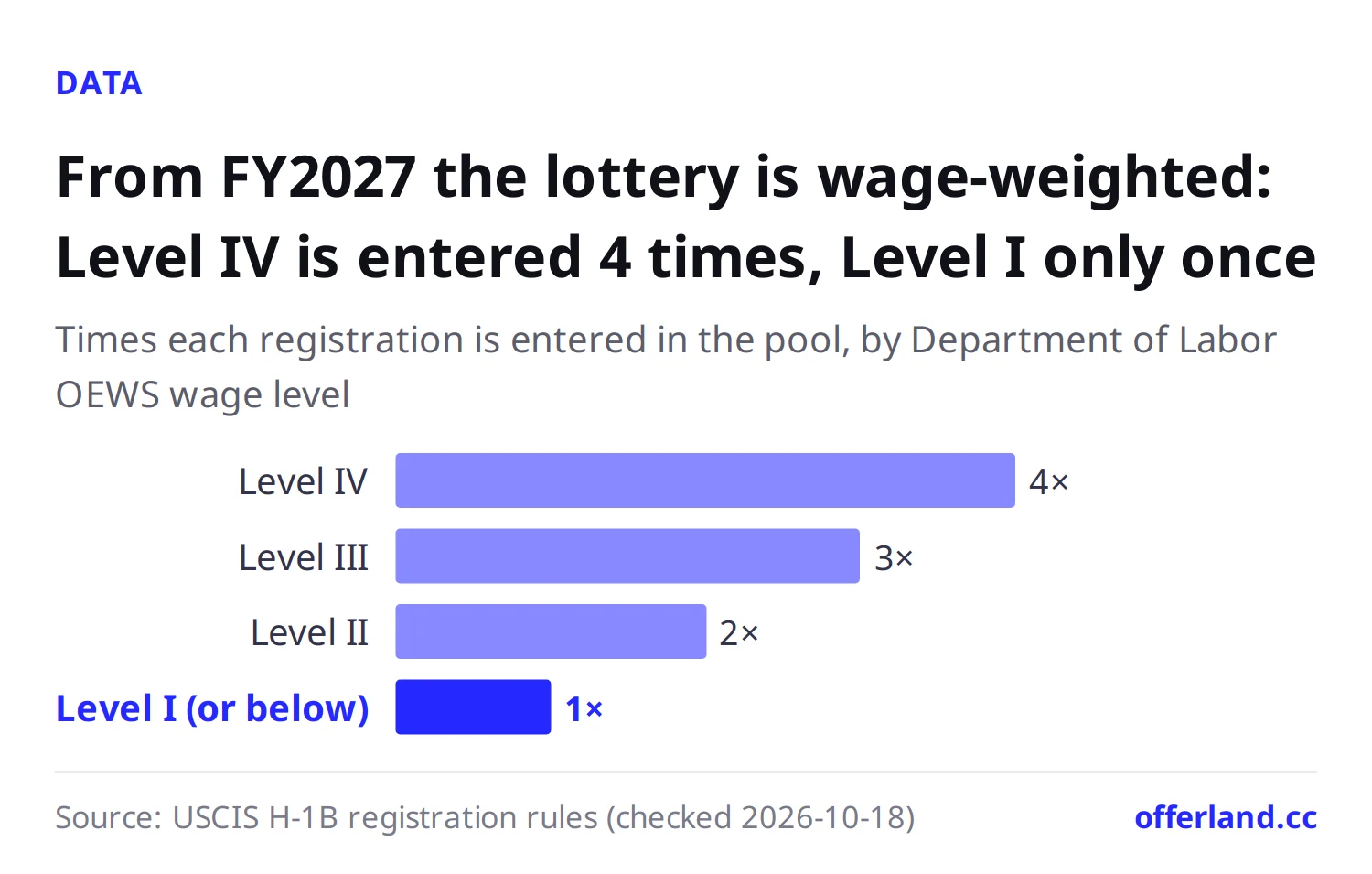
OEWS wage level | Entries in the selection pool |
|---|---|
Level IV | 4 times |
Level III | 3 times |
Level II | 2 times |
Level I (or below Level I) | 1 time |
New graduates' salaries often fall at Level I or II, so with weighting their odds may be lower than under the old purely random lottery. Each beneficiary still counts once; being registered by several companies doesn't add entries.
The table below shows selection rates calculated from the "eligible registrations" and "selected registrations" USCIS has published. The regular cap and master's cap are combined because USCIS doesn't publish them separately. FY2021 through FY2026 were still random lotteries, so these rates can't be used directly to estimate odds under weighting.
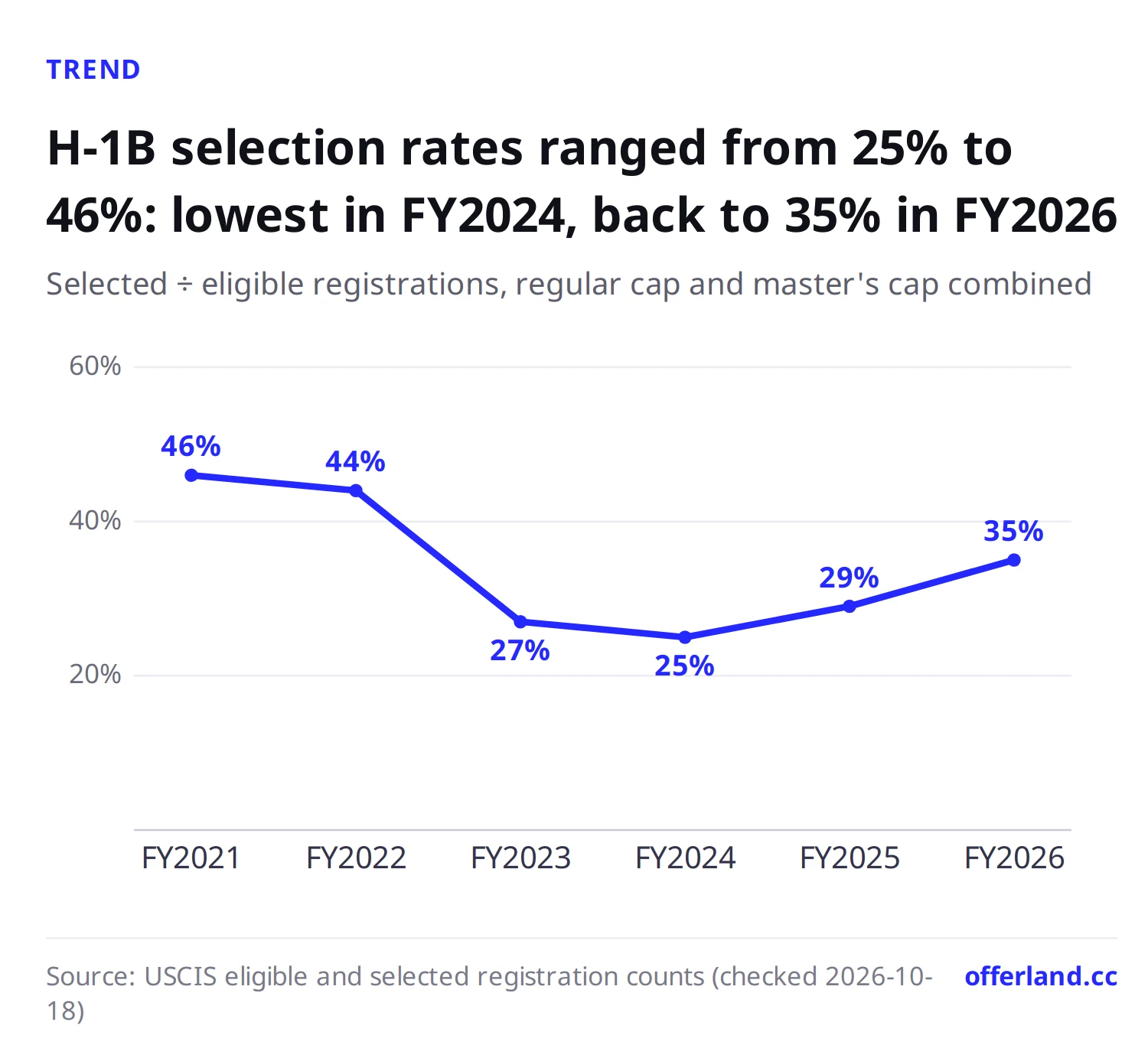
Fiscal year | Eligible registrations | Selected registrations | Selection rate |
|---|---|---|---|
FY2021 | 269,424 | 124,415 | 46% |
FY2022 | 301,447 | 131,924 | 44% |
FY2023 | 474,421 | 127,600 | 27% |
FY2024 | 758,994 | 188,400 | 25% |
FY2025 | 470,342 | 135,137 | 29% |
FY2026 | 343,981 | 120,141 | 35% |
Since FY2025, selection has been by beneficiary, which sharply cut the number of people with multiple registrations: in FY2024, 408,891 eligible registrations belonged to people registered more than once; in FY2026 there were only 7,828. FY2026 had about 339,000 eligible beneficiaries. As of October 18, 2026, USCIS has only announced that the FY2027 cap has been reached and hasn't published registration or selection numbers.
Timeline and fees: from graduation to H-1B start
The H-1B timeline is fixed: registration in March, results at the end of March, petitions filed from April 1, and the H-1B starting October 1. For FY2027, registration ran from March 4 to 19, 2026, USCIS announced on March 31 that the selection was complete, and selected employers have at least 90 days starting April 1 to file Form I-129.
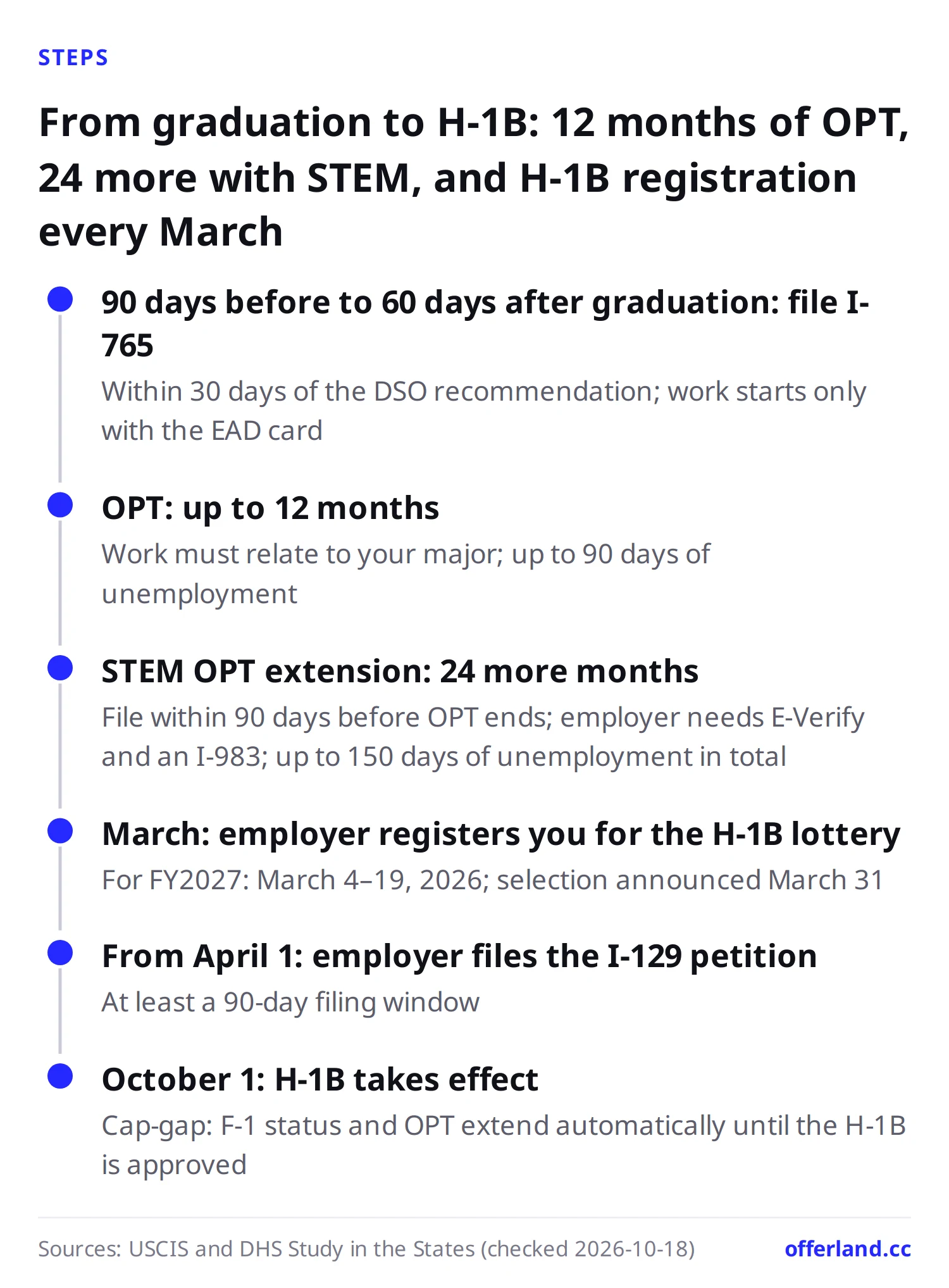
There is often a gap between OPT and the H-1B start date, known as the cap-gap. If the employer files the H-1B on time and requests a change of status, the student's F-1 status and OPT work authorization are automatically extended until the H-1B is approved, up to April 1 of that fiscal year at the latest.
Employers pay most H-1B costs. The table below follows the USCIS fee schedule (Form G-1055, October 16, 2026 edition).
Item | Amount (USD) | Paid by |
|---|---|---|
H-1B registration fee | 215 per person | Employer |
I-129 filing fee | 780 on paper, 730 online; 460 for small employers or nonprofits | Employer |
Asylum Program Fee | 600 standard, 300 for small employers, 0 for nonprofits | Employer |
Fraud Prevention and Detection Fee | 500 | Employer |
ACWIA fee | 1,500 or 750, depending on number of employees | Employer |
Pub. L. 114-113 fee | 4,000 (50 or more employees, with more than half on H-1B or L status) | Employer |
I-129 premium processing (optional) | 2,965 | Usually the employer |
There is also a $100,000 fee to watch for. A September 2025 presidential proclamation requires an extra $100,000 for certain H-1B petitions filed after September 21, 2025, where the beneficiary is outside the US and doesn't hold a valid H-1B visa. People changing from F-1 to H-1B inside the US are generally outside its scope, but it may still apply if USCIS finds the change of status invalid. On June 8, 2026, the federal district court in Massachusetts vacated the guidance implementing the fee; on July 24, the First Circuit Court of Appeals denied the government's motion for a stay, and DHS said it would comply with the court order. Then on September 18, 2026, the White House announced it was extending the fee. This is still in flux, so check the USCIS H-1B page before filing.
Also note the H-1B fee proposal DHS published on August 25, 2026: every cap-subject H-1B petition (including the master's cap) would carry an additional $103,265, and that includes people changing from F-1 to H-1B inside the US. For now this is only a proposal; as of October 21, 2026, no final rule had been published.
Two new changes in 2026
First, fixed periods of stay. Since September 15, 2026, newly admitted F students no longer get "duration of status." Instead they get a fixed period based on the program length on the I-20 (up to 4 years), plus a 30-day entry period and a 30-day departure period. As a result, the post-graduation departure grace period has dropped from 60 days to 30 days. If OPT or STEM OPT later runs past your period of stay, you must apply to USCIS for an extension of stay (Form I-539) together with your work authorization application, or leave the US and reenter. Students admitted under duration of status before September 15 can stay until the end of their I-20 program or OPT/STEM OPT, plus a 60-day departure period, but no later than November 14, 2030. Those who qualify for cap-gap don't need to apply separately for an extension of stay.
Second, the proposed OPT fee. On October 8, 2026, DHS published a proposal in the Federal Register to charge $70,000 per student for initial OPT and $30,000 for subsequent OPT, paid by the school before the DSO recommendation. It is only a proposal: the comment period runs until November 9, 2026, it is not in effect, and the final version may change.
How to use this information
Confirm STEM eligibility when choosing schools. Among programs with similar names, some have a CIP code on the STEM list and some don't, which is the difference between 12 and 36 months of OPT. Ask the school directly which CIP code will be on your I-20.
File for OPT 3 months before graduation. You can file as early as 90 days before graduation. You can't start work without your EAD, and filing late can hold up the start date on your offer.
Watch your unemployment days. OPT allows 90 days cumulative, or 150 days in total with the STEM extension; going over can terminate your status. While job hunting, work out exactly when the count starts.
Ask about the H-1B when discussing an offer. Whether the employer will register you for the H-1B, which wage level the position falls under, and who pays the fees all affect your chances of staying. With weighted selection, wage level matters more.
Follow official announcements. 2026 brought fixed periods of stay, and the OPT fee proposal is still open for comment, so policy may change again before you graduate. Read the notices your school's international student office sends.
If you're still choosing schools, use the admission results search to see where applicants with similar backgrounds were admitted, or read the 2026 admissions report. For the experience of people who went from OPT to the H-1B, see the forum post How do you get a US work visa? What are OPT and H1B?.
FAQ
How long can I work on OPT?
Regular OPT is up to 12 months per degree level. If your major is on the DHS STEM list, you can extend it by another 24 months, for up to 36 months in total.
When can I apply for OPT?
You must file Form I-765 within 30 days after your DSO recommends you in SEVIS, and the filing window runs from 90 days before to 60 days after graduation. You can start work only once you have your EAD card.
What are the odds in the H-1B lottery?
Based on USCIS figures, selection rates from FY2021 to FY2026 ranged from 25% to 46%, with FY2026 at about 35%. From FY2027, selection is weighted by wage level, and higher levels get better odds, so the old numbers don't apply directly.
Does a US master's degree help in the H-1B lottery?
Yes. People with a US master's degree or higher are first entered in the regular-cap lottery and, if not selected, get another draw for the 20,000 master's cap slots. The degree must come from a US institution of higher education.
Does the $100,000 H-1B fee affect F-1 students?
The fee targets petitions where the beneficiary is outside the US and doesn't have a valid H-1B visa; it generally doesn't apply to people changing status from F-1 inside the US. In 2026 a court vacated the implementing guidance, and in September the White House announced it was extending the fee, so the situation is still in flux. Go by USCIS announcements.
About the data
This is a guide and does not use OfferLand's application results data. The H-1B selection rates are our own calculations from the "eligible registrations" and "selected registrations" USCIS has published. They cover both the regular cap and the master's cap and are not anyone's individual odds of selection. All rules and fees were verified on October 18, 2026. Immigration rules and fees can change at any time, so before applying, go by the latest announcements from USCIS and DHS Study in the States, and consult your school's DSO or an immigration attorney about your own situation. This article is not legal advice.
USCIS, "Optional Practical Training (OPT) for F-1 Students," updated November 25, 2024.
USCIS, "Optional Practical Training Extension for STEM Students (STEM OPT)," updated January 30, 2026.
USCIS, Form G-1055 fee schedule, October 16, 2026 edition.
USCIS, "H-1B Electronic Registration Process," "H-1B Cap Season," and "H-1B Electronic Registration Frequently Asked Questions," updated September 21, 2026.
USCIS, "FY 2027 H-1B Initial Registration Selection Process Completed," March 31, 2026.
USCIS, "H-1B Specialty Occupations," updated September 21, 2026; "Presidential Proclamation on Restriction on Entry of Certain Nonimmigrant Workers."
The White House, H-1B program fact sheet, September 18, 2026.
DHS Study in the States, "F-1 Optional Practical Training (OPT)," "STEM OPT Extension Overview," and "Unemployment Counter."
DHS Study in the States, announcement of the final rule on fixed periods of stay (July 2026); "Elimination of Duration of Status Frequently Asked Questions" (updated August 31, 2026).
DHS Study in the States and DHS press release, OPT fee proposal, October 7, 2026.
OfferLand editorial team · Jason · Last updated 2026-10-22 · About the editorial team
See which schools admitted applicants with a background like yours
Search results